


Upwork Alternative for No-Code Development
Most no-code work is scoped before anyone is hired — a Webflow site, an Airtable base, a Zapier route between two systems you already run. Upwork answers that with proposals: specialists buy Connects to bid, a service fee comes out of what they earn, and the money waits out a security period. Zinn Hub® is an Upwork alternative for no-code development that works the other way round — you order a published Zinn® at its listed price, and the Zinner®'s share is released at checkout.
Browse Verified Zinners →Why Look for an Upwork Alternative for No-Code Development?
No-code has become a proper professional discipline, and Upwork is one of the main places it gets bought and sold. It is a serious platform: hourly contracts with time tracking, fixed-price contracts paid against milestones held in escrow, and a dispute process behind both. The question here is narrower — whether a proposal-led model fits work that is usually specified before anyone is hired.
Three frictions come up repeatedly, and none is an accusation. The first is on the buying side: a no-code brief is normally concrete, naming the tools, the records and the trigger, yet the proposal model asks you to publish it and then read a shortlist you did not request. The second is on the building side, where a specialist spends Connects to be considered before any money has arrived. The third is measurement — hourly tracking records presence, which suits open-ended discovery better than a finished automation that either fires correctly or does not.
Zinn Hub answers those points with a different model rather than a better version of the same one. Buyers order a published Zinn directly, or post a brief at no cost. Zinners pay 0% commission on their first $500, then tiered rates that fall as they sell, as low as 7%. Payouts are released at checkout, and buyers pay no platform fee. Browse programming and tech, graphics and design, digital marketing or writing and translation to see how no-code specialists position their work.
0%
Commission on the first $500
Instant
Payouts at checkout
100+
Payment methods
46
Site languages
4.9
Average rating from 39,000+ verified-purchase reviews
Five Frictions No-Code Buyers and Builders Describe
These are differences in model, not complaints. Each is a design decision that suits some projects and not others.
Paying to Quote
Connects are spent on proposals, not on won work. For a specialist whose builds are small and frequent, that is a standing cost attached to being considered rather than to delivering.
Hours Measure the Wrong Thing
No-code exists to compress build time. An hourly frame rewards the slower route, and nobody enjoys explaining why an automation that took two hours was the expensive kind of expertise.
A Shortlist You Did Not Ask For
When you already know you need a Make scenario between a form and a CRM, a round of proposals is a sorting exercise that happens before any of the work can begin.
Earned but Not Available
A security period sits between an approved contract and a withdrawal. For a builder paying for their own tool subscriptions each month, money that cannot move is a real constraint.
Stack Depth Reads as a Keyword List
Knowing where Bubble stops and a real backend has to start is judgement, not a tool badge. On a job board it compresses into a row of platform names that every profile carries.
Is Upwork Good for No-Code Work?
Yes, for a particular shape of project. If the requirement is genuinely open — an internal-tools programme that will run for months, or an hourly contract a finance department needs in order to approve the spend — Upwork's contracts, time tracking and dispute process do exactly what they were built to do.
It fits less well when the deliverable is already known and self-contained, when a build is small enough that the sorting effort outweighs it, or when the specialist's cash flow cannot absorb a security period on top of a payout. That is where a second platform earns its place. Read the broader Upwork alternative overview or the Zinn Hub vs Upwork comparison.
Zinn Hub vs Upwork for No-Code — the Model Difference
Two marketplaces, two designs. Neither is universally better; they suit different projects.
| How it works | Zinn Hub | Upwork |
|---|---|---|
| Finding the specialist | ✓ Order a published Zinn at its listed price | ~ Proposals, bid using Connects |
| Builder commission | ✓ 0% on the first $500, then as low as 7% | ~ Service fee on earnings |
| When the Zinner is paid | ✓ Their share is released at checkout | ~ After a security period |
| Buyer platform fee | ✓ None — listed price is the price | ~ Client-side charges apply |
| Zinnector®'s protection | ✓ Escrow until the order completes, refunds to the Zinn Wallet | ✓ Escrow on fixed-price milestones, plus disputes |
| Credibility signal | ✓ ID- and skill-verified Zinners | ✓ Badge tiers built on tenure |
| Open-ended builds by the hour | ~ Fixed-scope Zinns and briefs | ✓ Hourly contracts, time tracking |
| Existing client traffic | ~ Growing marketplace | ✓ Large established client base |
How No-Code Zinners Start on Zinn Hub
The setup is deliberately short, because nothing is spent before the first order arrives.
Verify Once
Complete ID and skill verification. That badge is what a first-time buyer reads instead of a tier.
List by Scope
Publish Zinns priced in US dollars, or start with Micro Zinns between $5 and $20 for a single automation.
Build in Escrow
The buyer pays upfront, the order is held in escrow, and files, access notes and messages stay in one thread.
Get Paid at Checkout
Your share is released at checkout — at 0% commission until you have passed $500 in sales.
Selling No-Code by Scope, Not by the Hour
Write the listing in tools and outcomes
The most useful thing a no-code Zinn can do is name the stack and the finished state. A five-page Webflow site built from your brand assets, responsive, with a CMS collection for the blog and two rounds of revisions, tells a buyer more than any adjective can. Do the same for automations: the trigger, the systems at either end, the error handling, and what happens to a record that fails validation.
Charge for judgement, not for keystrokes
Speed is the product in no-code, so an hourly frame quietly penalises the person who is best at it. A fixed price attached to a defined outcome pays for knowing which of six plausible approaches survives contact with real data — and for knowing when a client is better served by being told their requirement has outgrown the tool.
Let 46 site languages do the distribution
Zinn Hub renders in 46 site languages, buyers can be messaged in 58, and prices are displayed in 59 currencies. A listing written once in English is therefore discoverable by someone browsing in Spanish, German, Japanese or Portuguese — the cheapest expansion available to a no-code specialist. Write plain English with the specifics first: platform, deliverable, revision count, turnaround. That survives translation. Slang does not.
Make the handover part of the scope
No-code builds are usually inherited by someone who did not commission them, so state who owns the workspace, which seats and subscriptions the buyer will need, and what documentation ships with the delivery. Setting that out on the listing prevents the most common disagreement in this category. Our pricing page explains how orders are charged, and the refund policy covers undelivered work.
Who Should Choose Which
An honest split. Most people commissioning or building no-code work will recognise themselves in one column more than the other.
✅ Zinn Hub suits you if
- You can already describe the build, and would rather order it than advertise it
- You would rather publish a scoped service than pay to submit proposals
- Early earnings matter — 0% commission on the first $500, then rates as low as 7%
- You want your share released at checkout, not after a security period
- You would rather be judged on verification than on tenure
- Your buyers browse in languages other than English, or pay by card, PayPal or cryptocurrency
💡 Upwork still suits you if
- The requirement is open-ended and will be discovered as you go
- Clients need an hourly contract with tracked time
- You rely on its large established client base
- You have already earned a badge tier worth protecting
- You are content with the fees and payout timing as they stand
Popular No-Code Services on Zinn Hub
The work most often commissioned from no-code Zinners, and where to find it.
- No-code and low-code development — Webflow, Framer, Bubble, Softr and Glide builds.
- Workflow automation — Zapier, Make and n8n routes between the systems you already run.
- Airtable and Notion workspaces — bases, views, permissions and dashboards set up properly.
- Shopify and storefront builds — themes, apps and checkout tidy-ups.
- Programming and tech — for the point at which a build outgrows the tool.
- Micro Zinns — fixed-price services from $5 to $20, ideal for a single automation.
- Post a project — free to post, and verified Zinners respond.
Related Platform Comparisons
Weighing up more than one option? These cover the same ground from different angles.
Upwork Alternative
The overview, across every category rather than one. Read the overview →
Zinn Hub vs Upwork
The two models set side by side in detail. Read the comparison →
All Alternatives
Every platform comparison we publish, in one index. Browse alternatives →
Browse Digital Services
Search the marketplace directly for the work you need done.
Build Without Bidding
List your no-code services in USD, pay 0% commission on your first $500, and take your share at checkout. Buyers pay no platform fee, and their payment is protected by escrow until the order completes.
Become a Zinner →Top Zinns ⚡
-
 precisely convert figma to webflow , adobe xd to webflow website in 24 hours Verified Trusted Zinner Hot Zinner Zinner Level 4I will convert Figma or Adobe XD to a responsive 1-page Webflow website. | Premium Webflow Partner with Over 8 Years of…
 - convert lovable to ios and android using capacitor Verified Trusted Zinner Hot Zinner Zinner Level 4Fix the bug in your no code App
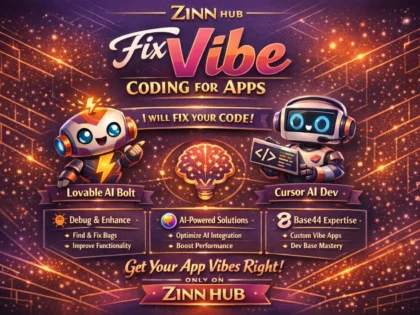
- fix vibe coding for apps with lovable ai bolt and cursor ai dev base44 Verified Trusted Zinner Hot Zinner Zinner Level 4Get a simple, functional app 1-2 features with fixes. ~20hrs of effort | Premium tech team with global expertise
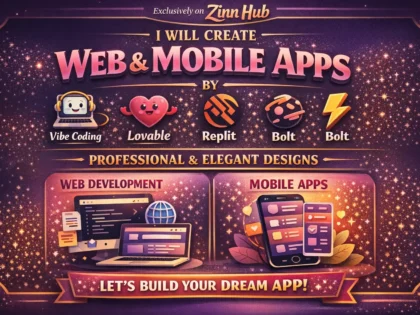
- create web, mobile app by vibe coding, lovable, replit, bolt Verified Trusted Zinner Hot Zinner Zinner Level 4In the 8 Hours you can assign any kind of task related AI script setup or development | Innovative Mobile App and…
- built your responsive website in bubble io Verified Trusted Zinner Hot Zinner Zinner Level 41 Page Responsive Website with functionality. (Contact before placing order) | Full Stack Developer
- I Will Build Your Zapier or Make Automation Workflow Verified Trusted Zinner Hot Zinner Zinner Level 4Stop wasting time on manual tasks. I'll connect your apps, build smart automations, and integrate APIs so your business runs on autopilot…



Explore More Upwork Alt: No-Code Development Options
Discover related marketplaces, locations, sell your services pages, and alternatives on Zinn Hub
Browse Categories
Sell Your Services
Other Upwork Alternatives
Show 50 more ▾
Similar Alternatives
Compare Platforms
Switch to Zinn Hub
Frequently Asked Questions
No-code hiring, payouts and how the two models differ — answered plainly.
Upwork is a global freelancing platform built around job posts and proposals. A client describes a piece of work, freelancers submit proposals, and the two sides agree either an hourly contract tracked by the platform or a fixed-price contract paid against milestones held in escrow. Freelancers spend Connects, the platform's proposal credits, in order to bid, and Upwork takes a service fee from freelancer earnings while charging the client side separately. It also runs badge tiers that reward a sustained track record. It is an established, widely used marketplace and a sensible place to commission no-code work.
On the buying side, a no-code build is usually well defined before anyone is hired: a Webflow site, an Airtable base, a Make or Zapier automation between two systems that already exist. Running a proposal round for a job you can already scope means reading a shortlist you did not ask for. On the building side, the bidding model asks a specialist to spend Connects before any money has arrived, hourly tracking suits exploratory work rather than a fixed automation, and earnings then wait out a security period before they can be withdrawn.
It is a different model rather than a better version of the same one. Zinn Hub is listing-led, so you order a published Zinn from a no-code specialist instead of collecting proposals, and there are no bidding credits to buy. Zinners pay 0% commission on their first $500 in sales, then tiered rates as low as 7%, and their share is released at checkout rather than after a security period. Buyers pay no platform fee, so the listed price is the price, the payment is held in escrow until the order completes, and an approved refund returns to the Zinn Wallet. Upwork keeps its large client base and its tracked hourly contracts.
The usual spread of the modern no-code stack: Webflow, Framer and WordPress builds; Bubble, Softr and Glide applications; Airtable and Notion workspaces with the views and permissions set up properly; Zapier, Make and n8n automations wiring a form to a CRM to a spreadsheet; Shopify storefronts; and AI-assisted workflows that summarise, route or enrich records. Because every listing states its own scope, revisions and turnaround, you can compare two Zinns on deliverables rather than on how persuasive a proposal reads. Micro Zinns, priced between $5 and $20, are a low-risk way to test a single automation before commissioning a whole build.
No. Zinn Hub charges buyers no platform fee, so the price shown on a Zinn is the price at checkout, in US dollars. Posting a project brief is free as well, so a team that would rather describe the workflow and let specialists respond can do that without paying anything to start. Zinn Hub accepts more than 100 payment methods, including card, PayPal and cryptocurrency, and the reviews on a Zinner's profile come only from confirmed purchases.
Pricing and settlement are in US dollars. The Zinner's share of an order is released at checkout rather than after a security period, so the only wait left is whatever their own payout method takes. The buyer is protected on the other side of the same order: the payment is held in escrow until the order completes, and an approved refund returns to their Zinn Wallet. Zinners are verified by ID and by skill before they can sell, which is what a first-time buyer reads instead of a tier badge.