Hire Prompt Engineering Specialists
The quality of every AI output your business produces is determined by the quality of the prompt behind it — and the gap between an amateur prompt and a professionally engineered one is the gap between AI that frustrates your team with inconsistent, unusable outputs and AI that delivers reliable, production-grade results every time. Prompt engineering is not about finding magic words — it is a systematic discipline of instruction design, testing and iteration that turns general-purpose AI models into precise tools for your specific tasks.
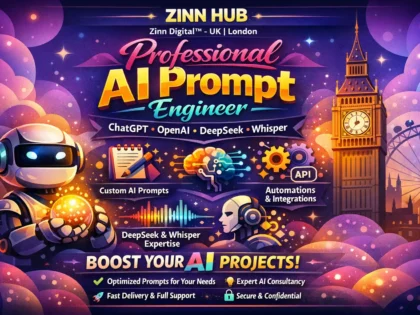
On Zinn Hub, experienced prompt engineers build custom prompts, prompt libraries, multi-prompt systems, system prompts for chatbots and agents, structured output pipelines and prompt evaluation frameworks for businesses deploying AI at every scale. These are specialists who understand how language models interpret instructions, how different models respond to different techniques, and how to build prompts that work reliably in production — not just in one-off demonstrations. Pay with crypto on every listing and your first $500 is commission-free.
Why Professional Prompt Engineering Matters
Most businesses using AI are leaving enormous value on the table because their prompts are unengineered — written conversationally, tested on one or two examples, and deployed without systematic evaluation. The result is AI outputs that work sometimes but fail unpredictably, require extensive human editing, return inconsistent formats, hallucinate information, miss edge cases, and gradually erode team confidence in AI as a tool. Professional prompt engineering eliminates these problems systematically. A well-engineered prompt includes a system prompt that anchors the model's behaviour, explicit instructions covering every aspect of the desired output, few-shot examples that demonstrate exactly what success looks like, output format specifications that ensure consistent structure, guardrails that prevent common failure modes, and documentation so your team can use and maintain it. The difference is measurable — professionally engineered prompts typically improve output accuracy from 60-70% to 90-95%, eliminate the need for human reformatting, reduce token usage by removing unnecessary verbosity, and provide consistent results across thousands of executions rather than unpredictable quality that varies with every run.
Prompt Engineering Services on Zinn Hub
- Custom Prompt Development — Purpose-built prompts for specific business tasks with system prompts, few-shot examples, output specifications and guardrails. Optimised for your AI model, your data and your quality requirements.
- Prompt Optimisation — Systematic improvement of existing prompts that produce inconsistent, verbose or inaccurate results. Iterative testing, instruction refinement, example tuning and failure mode analysis to achieve reliable production quality.
- Prompt Library Development — Comprehensive prompt collections organised by department, workflow or task type. Each prompt documented with purpose, variables, examples, model compatibility, limitations and version history.
- AI Prompt Systems & Chains — Multi-prompt architectures where outputs chain between prompts in sequence — research-then-write, extract-then-analyse, classify-then-route — handling complex workflows that exceed single-prompt capabilities.
- System Prompt Design — Persona definition, behaviour boundaries, response formatting, conversation management and tool-calling logic for customer-facing chatbots, internal AI assistants and agent-based applications.
- Prompt Templates & Variable Systems — Reusable prompt frameworks with clearly defined input variables that non-technical team members can populate for consistent AI outputs across the organisation.
- Prompt Evaluation & Benchmarking — Systematic testing across diverse inputs with quantified accuracy, consistency and failure mode metrics. Comparative analysis across prompt variants to identify the highest-performing approach.
- Model Comparison & Prompt Adaptation — Testing the same tasks across GPT-4, Claude, Gemini, Mistral and other models to determine the optimal model-prompt combination for your use case and budget.
- Structured Output Prompting — Engineering prompts that reliably return JSON, XML, CSV, markdown or other machine-parseable formats for integration into automated workflows and data pipelines.
- Prompt Documentation & Training — Comprehensive guides teaching your team how to use, modify, test and maintain prompt systems independently, including model-specific best practices and troubleshooting procedures.
Prompt Engineering vs Fine-Tuning
Prompt engineering and model fine-tuning are complementary approaches to customising AI behaviour, but they serve different purposes. Prompt engineering works with the model as-is — optimising instructions to get the best results from a general-purpose model without modifying the model itself. It is faster to implement, requires no training data, and adapts instantly to new requirements. Fine-tuning trains the model on your specific data to permanently alter its behaviour, which is more effective when you need the model to learn domain knowledge, match a specific writing style, or handle tasks that are too specialised for prompting alone. In practice, prompt engineering should always be the first approach — it is faster, cheaper and more flexible. Fine-tuning should only be considered when optimised prompts cannot achieve the required quality, when you need to reduce token usage by encoding instructions into the model itself, or when the task requires domain expertise that cannot be conveyed through prompt context alone.
Related Services
Prompt engineering connects with other AI development and automation services on Zinn Hub. For building automated workflows that use engineered prompts as AI-powered steps, browse AI automation and workflow services. For AI systems that search your documents and use prompts to generate answers, see RAG and knowledge base development. For building AI-powered applications with visual tools rather than code, explore no-code and low-code development. For custom AI model training, fine-tuning and deployment beyond prompt engineering, browse the AI development parent category. For content creation where AI-generated drafts need human refinement, see writing and content services.
Are you an experienced prompt engineer? Start selling prompt engineering services on Zinn Hub and connect with businesses worldwide that need expert prompt design for ChatGPT, Claude and other AI models. Register as a Zinner for free and start listing today.
How to Hire a Prompt Engineering Specialist
Define Your AI Tasks and Requirements Identify the specific tasks you need AI to perform — content generation, data extraction, classification, summarisation or analysis. Specify the AI model you use, the output format required, accuracy standards, and any domain-specific terminology or constraints.
Choose a Prompt Engineering Specialist Browse prompt engineering services on Zinn Hub. Review portfolios for experience with your AI model and industry domain. Check buyer reviews for output quality, consistency and documentation. Message specialists to discuss your tasks and quality requirements.
Provide Context and Sample Data Share examples of desired outputs, sample inputs covering common cases and edge cases, brand voice guidelines if applicable, domain-specific terminology, and any existing prompts that need improvement. The more context you provide, the more precise the results.
Test, Validate and Deploy Review delivered prompts with your own test inputs. Verify accuracy and consistency across diverse scenarios. Review testing results and documentation. Deploy into your workflows or provide to your team with accompanying usage guides.
Frequently Asked Questions About Prompt Engineering
What prompt engineering services can I buy on Zinn Hub?+
Zinn Hub offers a full range of prompt engineering services from experienced AI specialists. You can buy custom prompt development — purpose-built prompts for specific business tasks like content generation, data extraction, customer service responses, code generation, analysis and summarisation, engineered with system prompts, few-shot examples, output format specifications and guardrails. Prompt optimisation — taking existing prompts that produce inconsistent, verbose or inaccurate results and systematically improving them through iterative testing, prompt restructuring, instruction refinement and output format tuning. Prompt library development — building comprehensive prompt collections organised by task type, department or workflow, with documentation, variable templates, versioning and usage guidelines for teams. AI prompt systems — multi-prompt architectures where prompts chain together in sequences, with the output of one prompt feeding into the next, handling complex multi-step tasks like research-then-write, extract-then-analyse or classify-then-route workflows. System prompt design for chatbots and agents — defining persona, behaviour boundaries, response formatting, tool-calling instructions and conversation management for customer-facing AI assistants. Prompt templates with variable injection — reusable prompt frameworks with clearly defined input variables that non-technical team members can populate for consistent AI outputs across the organisation. Prompt evaluation and benchmarking — systematic testing of prompts across diverse inputs to measure accuracy, consistency, edge case handling and failure modes with quantified results. Model comparison and prompt adaptation — testing the same task across GPT-4, Claude, Gemini, Mistral and other models to determine which model-prompt combination delivers the best results for your specific use case. Structured output prompting — engineering prompts that reliably return JSON, XML, CSV, markdown tables or other machine-parseable formats for integration into automated workflows. And prompt documentation and training — creating guides that teach your team how to use, modify and maintain prompt systems independently.
How much do prompt engineering services cost on Zinn Hub?+
Costs depend on the complexity of the task, the number of prompts required and the depth of testing involved. A single optimised prompt for a specific business task — with system prompt, few-shot examples, output formatting and edge case handling — costs $50-200. A prompt optimisation engagement taking an existing underperforming prompt and systematically improving it through iterative testing costs $75-300. A prompt library of ten to twenty prompts for a department or workflow, with documentation, variable templates and usage guides, costs $300-1000. A multi-prompt chain or prompt system for a complex workflow — research, extraction, analysis and generation in sequence — costs $300-1200. System prompt design for a customer-facing chatbot or AI assistant with persona definition, behaviour rules, tool-calling logic and conversation management costs $200-800. Prompt evaluation and benchmarking across multiple test cases with quantified accuracy and consistency metrics costs $200-600. Model comparison testing the same prompts across three or more AI models with performance analysis costs $200-700. A comprehensive prompt engineering engagement covering discovery, development, testing, documentation and team training for an organisation-wide AI deployment costs $1000-5000. Ongoing monthly prompt maintenance — monitoring output quality, adapting to model updates, and iterating based on user feedback — typically ranges from $100-500 per month.
What is prompt engineering and why does it matter?+
Prompt engineering is the practice of designing, structuring and optimising the instructions you give to AI language models to get reliable, high-quality outputs for specific tasks. The same AI model can produce dramatically different results depending on how the prompt is written — a well-engineered prompt produces consistent, accurate, properly formatted outputs while a poorly written prompt produces vague, inconsistent or incorrect responses. Prompt engineering matters because AI models do not read minds — they follow instructions literally and interpret ambiguity in unpredictable ways. The difference between asking a model to summarise a document and providing a structured prompt with specific instructions about length, format, audience, key points to emphasise and information to exclude is the difference between a generic paragraph and a precise, usable summary. For businesses integrating AI into their operations, prompt quality directly determines whether AI tools deliver genuine value or produce outputs that require so much human editing they save no time at all. Prompt engineering encompasses several techniques — system prompts that define the model's role and behaviour, few-shot examples that demonstrate the expected output format, chain-of-thought instructions that improve reasoning on complex tasks, output format specifications that ensure machine-parseable responses, and guardrails that prevent the model from generating inappropriate, off-topic or hallucinated content. It is a technical skill that combines understanding of how language models process instructions with domain expertise in the specific task being automated.
What is the difference between prompting ChatGPT, Claude and other AI models?+
Different AI models respond to prompting techniques differently because they were trained with different data, architectures, instruction-tuning approaches and safety mechanisms. OpenAI GPT-4 and GPT-4o respond well to detailed system prompts, follow JSON output schemas reliably when instructed, and handle function calling and tool use effectively. GPT models tend to be verbose by default so prompts often need explicit length constraints. The models follow the OpenAI API format with distinct system, user and assistant message roles. Anthropic Claude models — Claude Opus, Sonnet and Haiku — are particularly strong at following nuanced, detailed instructions and tend to be more literal in their interpretation of prompts. Claude responds well to XML-tagged prompt structures, handles very long contexts effectively, and is generally more conservative about making assumptions. Claude uses a system prompt field separate from the conversation and excels at maintaining consistent behaviour across long interactions. Google Gemini models handle multimodal inputs — text, images, audio and video — natively and integrate well with Google's ecosystem. Prompting for Gemini requires attention to its specific safety filters which are more aggressive than some alternatives. Open-source models like Mistral, Llama and Mixtral vary significantly in their prompting requirements depending on the specific model version and fine-tuning. They often require more explicit instruction formatting and may not follow complex output schemas as reliably as frontier commercial models. The practical implication is that prompts optimised for one model do not automatically transfer to another — a prompt that works perfectly on GPT-4 may produce different results on Claude and vice versa. Professional prompt engineering involves understanding these model-specific behaviours and optimising accordingly.
What are system prompts and why are they important?+
A system prompt is a set of instructions provided to an AI model that defines its role, behaviour, constraints and output format before any user interaction begins. It is the foundational layer of prompt engineering — everything the model does in a conversation or task is shaped by the system prompt. System prompts are important because they establish consistent behaviour that persists across every interaction. Without a system prompt, the model uses its default behaviour which is generic and not tailored to your specific use case. A well-designed system prompt defines the model's persona — whether it should act as a customer service representative, a technical analyst, a creative writer or a data extraction tool. It specifies response formatting — whether outputs should be JSON, markdown, bullet points, specific templates or natural prose. It sets behavioural boundaries — topics to avoid, types of questions to escalate to humans, information to never disclose, and how to handle edge cases. It provides domain context — background information about your company, products, terminology and processes that the model needs to reference. And it defines tool-calling behaviour — when and how the model should use external tools like search, database queries or API calls. For customer-facing AI applications, the system prompt is the primary mechanism that controls the user experience. For backend AI integrations in workflows, the system prompt ensures that outputs are consistently formatted and parseable by downstream systems. Poorly designed system prompts are the single most common cause of AI applications that behave unpredictably, generate off-brand content, or fail to handle real-world inputs reliably.
What are few-shot examples and when should I use them?+
Few-shot examples are sample input-output pairs included in a prompt that demonstrate exactly what the model should produce. Instead of only describing the desired output in words, you show the model concrete examples of inputs and their corresponding correct outputs. The model uses these examples to understand the pattern, format, tone and level of detail expected. Few-shot examples are most effective when the output format is complex or specific — if you need the model to return data in a particular JSON structure, showing two or three examples of correct JSON outputs is far more reliable than describing the structure in words. When the task involves judgment or style that is hard to articulate — if you need product descriptions in a particular brand voice, examples of that voice are more effective than adjectives describing it. When the task involves classification into categories that are domain-specific — showing examples of how similar items were classified teaches the model your specific taxonomy. When the output requires a specific level of detail — examples demonstrate whether you want one-sentence summaries or multi-paragraph analyses. The typical approach is to include two to five examples — enough to establish the pattern without consuming too much of the model's context window. Each example should be representative of the common cases and at least one should demonstrate edge case handling. The examples should be diverse — if all examples look identical, the model may overfit to superficial patterns rather than learning the underlying logic. For production systems, few-shot examples are often the difference between a prompt that works 60% of the time and one that works 95% of the time, because they eliminate ambiguity that written instructions alone cannot resolve.
How do I get AI models to return structured data like JSON reliably?+
Getting AI models to return valid, parseable structured data consistently requires several prompt engineering techniques used together. First, specify the exact output format in the system prompt with a schema definition — list every field, its data type, whether it is required or optional, and any constraints on values. Second, provide few-shot examples showing complete, valid JSON outputs for representative inputs — the model learns the structure from examples more reliably than from descriptions alone. Third, explicitly instruct the model to return only the JSON object with no additional text, explanation, markdown formatting or code fences around it — models often add explanatory text before or after JSON unless told not to. Fourth, use a structured output mode if the API supports it — OpenAI offers JSON mode and structured outputs with schema enforcement, and Anthropic Claude supports tool-use responses that return structured data reliably. Fifth, implement validation in your application — parse the response, validate it against your schema, and implement retry logic that re-prompts the model with the validation error if the output is malformed. For critical production workflows, the combination of a well-engineered prompt with structured output API features and application-level validation creates a reliable pipeline. Common failure modes include the model wrapping JSON in markdown code blocks, adding explanatory text before or after the JSON, using inconsistent field names, omitting optional fields unpredictably, and returning nested structures differently than specified. Each of these is addressable with specific prompt instructions and examples. Specialists on Zinn Hub build prompt systems that return structured data reliably at production scale with proper error handling.
What is chain-of-thought prompting and when should I use it?+
Chain-of-thought prompting is a technique where you instruct the model to work through a problem step by step, showing its reasoning process before arriving at a final answer. Instead of asking the model to jump directly to a conclusion, you ask it to break the problem into steps, reason through each step explicitly, and then synthesise its reasoning into a final response. This technique significantly improves accuracy on tasks that require multi-step reasoning — mathematical calculations, logical deductions, code debugging, complex analysis, comparisons involving multiple criteria, and any task where the correct answer depends on correctly processing intermediate steps. Without chain-of-thought, models often skip steps and produce plausible-sounding but incorrect answers because they jump to pattern-matched conclusions rather than reasoning through the logic. The simplest implementation is adding instructions like "think through this step by step" or "reason through each factor before reaching your conclusion." More sophisticated implementations provide explicit reasoning frameworks — "First, identify the relevant factors. Second, evaluate each factor. Third, weigh the factors against each other. Finally, state your conclusion with your confidence level." For production systems where you need the final answer without the reasoning, you can instruct the model to perform its reasoning inside designated tags and provide the final answer separately, or use a two-step approach where the first call generates reasoning and the second call extracts just the conclusion. Chain-of-thought does consume more tokens which increases cost and latency, so it should be used selectively for tasks where accuracy matters more than speed, not for simple classification or formatting tasks where the model already performs well without it.
How do I build a prompt library for my team?+
A prompt library is a structured collection of tested, documented prompts that your team uses for recurring AI tasks — ensuring consistent quality and eliminating the inefficiency of everyone writing prompts from scratch. Start by auditing how your team currently uses AI — identify every task where team members interact with AI models, whether through ChatGPT, Claude, API integrations or workflow automations. Categorise these tasks by function — content creation, data analysis, customer communication, code generation, research, summarisation and so on. For each task, develop an optimised prompt with a system prompt that defines the model's role, detailed instructions covering common variations and edge cases, few-shot examples demonstrating the expected output, clearly defined input variables that users fill in, and output format specifications. Document each prompt with its purpose, the model it was optimised for, the input variables and their expected formats, example inputs and outputs, known limitations and edge cases, and version history. Organise the library by department, workflow or task type so team members can find the right prompt quickly. Store the library in a shared location your team already uses — a Notion database, Google Doc, internal wiki or dedicated prompt management tool. Include version control so you can track changes, roll back to previous versions, and test updates before deploying them. Establish a feedback loop — when team members find a prompt produces poor results for a specific input, log it, investigate, and update the prompt. Schedule periodic reviews to adapt prompts when AI models are updated, since model updates can change how prompts perform. Prompt libraries on Zinn Hub are built as complete, ready-to-deploy systems with documentation and training for your team.
How do I choose a prompt engineering specialist on Zinn Hub?+
When choosing a prompt engineering specialist on Zinn Hub, look for demonstrated experience with the specific AI model you use — GPT-4, Claude, Gemini and open-source models each require different prompting approaches, and expertise with one does not automatically transfer to others. Review their portfolio for prompt engineering projects similar to yours in domain and complexity. If you need prompts for a specific industry — legal, medical, financial, ecommerce or technical — check that they have experience with the terminology, constraints and accuracy requirements of that domain. Read buyer reviews for feedback on output quality, consistency, documentation and the degree to which prompts worked reliably in production rather than just in demonstrations. Ask about their testing methodology — professional prompt engineers test across diverse inputs, measure accuracy and consistency quantitatively, deliberately test edge cases and failure modes, and iterate based on results rather than intuition. Ask what deliverables they provide — you should receive the complete prompt text, system prompt, few-shot examples, input variable definitions, output format specifications, testing results showing accuracy across test cases, and documentation explaining the reasoning behind design decisions. Ask about model update resilience — how they design prompts to be robust against the behaviour changes that occur when AI providers update their models. For prompt libraries and multi-prompt systems, ask about their approach to organisation, versioning and maintenance. Message specialists before ordering to discuss your specific use case, the AI model you use, and the quality standards your outputs need to meet.



 ✓
✓ ✓
✓ ✓
✓ ✓
✓ ✓
✓ ✓
✓ ✓
✓ Zinn Digital® LTD