


THE DATA ANNOTATION SERVICES MARKETPLACE
Buy Data Annotation Services from Verified Experts
The marketplace where machine learning teams, research groups and product owners hire annotators and labelling specialists. Bounding boxes and segmentation masks, text classification and named entity tagging, audio labelling, LLM preference ranking and dataset QA — priced in USD, with no buyer platform fee.
Data Annotation Services Available
Image Bounding Boxes and Classification
The most common computer vision task: drawing tight rectangles around objects and assigning each one a class, or tagging whole images against a label set. Delivered as COCO, YOLO, Pascal VOC or a plain CSV you specify.
Semantic and Instance Segmentation
Pixel-level or polygon-level labelling where a box is too coarse — medical imaging, agriculture, autonomous systems, satellite work. Much slower per image than boxes, so scope it deliberately and price it separately.
Text Classification and NER
Tagging documents, tickets, reviews or messages against a taxonomy, or marking named entities such as people, organisations, products, dates and amounts inside running text. Usually delivered as JSONL with character offsets.
Audio and Speech Labelling
Speaker diarisation, intent and sentiment tagging, wake-word marking, event detection and verbatim transcription used as ground truth. Ask for the timestamp precision you need, because it changes the cost significantly.
LLM Data: Ranking and Instruction Pairs
Human preference ranking between model responses, writing instruction and response pairs, red-teaming prompts and rubric-based scoring. This work needs domain literacy far more than it needs annotation tooling.
Dataset QA, Audit and Relabelling
Reviewing an existing dataset rather than building one: sampling for error rate, measuring inter-annotator agreement, finding class imbalance and label leakage, and correcting the subsets that fail.
Who Buys Data Annotation Work
What to Look For in an Annotator
Labelled Data Is the Part of the Model You Can Actually Control
Architecture choices get the attention, but on most applied projects the label set is what moves the metric. A taxonomy with overlapping classes produces annotators who disagree, and a model cannot learn a boundary that humans cannot agree on. Ambiguous edge cases that nobody wrote a rule for get resolved differently by different people on different days. And a dataset that was never audited hides its error rate inside a validation score that looks fine.
Buying annotation as a defined deliverable — a named task type, a written guideline, an agreed output format and a stated quality bar — makes it inspectable. Zinn Hub lists annotation and labelling Zinns from verified Zinners, priced in USD, with no platform fee on the buyer side.
Pair annotation with the computer vision marketplace when you need the model built as well as the data, the MLOps marketplace for the pipeline that retrains on it, or the web scraping marketplace when the raw data has to be collected first.
🔥 Featured Data Annotation Services
Browse data annotation Zinns and the Zinners who offer them. Compare the task type, the data modality and the price listing by listing, and filter Zinners by category, minimum rating or Zinner type.
Top Zinns ⚡
-
 I Will Provide Ghostwriting, Virtual Assistance, Transcription, Translation, and Data Support Services Verified Zinner Level 1Reliable ghostwriting, book cover design, data annotation, customer support, virtual assistance, translation, and transcription — accurate, detail-oriented, and delivered on time by…
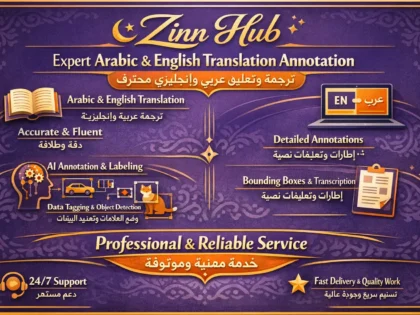
 - provide arabic and english translation annotation and ai annotation Verified Trusted Zinner Hot Zinner Zinner Level 4Localization, QA, Proofreading, For AI or Human use | Certified Translator, Researcher, and media specialist
- I Will Build a Custom Computer Vision & Deep Learning Model in Python Verified Trusted Zinner Hot Zinner Zinner Level 4Get a production-ready computer vision or deep learning model built on your custom image data — including data annotation, preprocessing, model creation,…
- I Will Build Python Machine Learning & Deep Learning Models Verified Trusted Zinner Hot Zinner Zinner Level 4Get a custom machine learning or deep learning model built in Python by a London-based team with 7 years of experience —…
- I Will Build a Custom Object Detection & Classification Model in Python Verified Trusted Zinner Hot Zinner Zinner Level 4Get a trained, validated object detection or classification model built with state-of-the-art architectures — including full source code — ready for your…




Explore the Full Data Annotation Marketplace
Browse annotation services, categories, specialists, live projects and guides from across Zinn Hub.
Zinns
- I Will Provide Ghostwriting, Virtual Assistance, Transcription, Translation, and Data Support Services Verified Zinner Level 1Reliable ghostwriting, book cover design, data annotation, customer support, virtual assistance, translation, and transcription — accurate, detail-oriented, and delivered on time by a seasoned freelancer with 10+ years…
- provide arabic and english translation annotation and ai annotation Verified Trusted Zinner Hot Zinner Zinner Level 4Localization, QA, Proofreading, For AI or Human use | Certified Translator, Researcher, and media specialist
- I Will Build a Custom Computer Vision & Deep Learning Model in Python Verified Trusted Zinner Hot Zinner Zinner Level 4Get a production-ready computer vision or deep learning model built on your custom image data — including data annotation, preprocessing, model creation, and optional cloud deployment — by…
- I Will Build Python Machine Learning & Deep Learning Models Verified Trusted Zinner Hot Zinner Zinner Level 4Get a custom machine learning or deep learning model built in Python by a London-based team with 7 years of experience — covering classification, regression, neural networks, computer…
Micro Zinn Categories
Freelancers
- Abdelkader Khatir Verified Available now Verified Zinner Level 1Data annotation specialist
- Noor Alam Verified Available now Verified Zinner Level 1Data Entry | Web Research | Data Annotation
- Buds Vadillo Verified Available now Verified Zinner Level 1Customer Support Specialist | Virtual Assistant | 15+ Years BPO Experience



Freelancer Categories
Articles
- Data Annotation Marketplace
- Computer Vision Marketplace 👁️ Computer Vision Specialists Hire Verified Computer Vision Engineers Find computer vision engineers who build custom models for object detection, image recognition, OCR and video analysis — trained…
Help
Why Buy Data Annotation on Zinn Hub?
Labelling is bought in batches. The platform is built so a pilot costs almost nothing and tells you almost everything.
Task Types, Not Job Titles
Zinns are listed by the annotation task — boxes, polygons, keypoints, entities, intents, rankings — so you can compare quotes for the same work instead of comparing self-descriptions.
Cheap Pilots
Micro Zinns are fixed-price services at $5, $10, $15 or $20, which makes a hundred-item pilot with three different annotators a routine decision rather than a budget conversation.
Verified Zinners
Zinners are verified with government-issued photo ID and evidence of their skills and past work — relevant when your training data leaves your systems for the first time.
Platform Protected Payments
Choose a Platform Protected Zinner and your payment is held by Zinn Hub until the order completes. Refunds are credited to your Zinn Wallet in full, in USD.
Batch, Review, Repeat
Buy in batches rather than one enormous order. Each batch gives you a real error rate to feed back into the guidelines, which is how annotation quality actually improves.
Reviews From Real Orders
Reviews on Zinn Hub require a confirmed purchase, so the feedback on an annotator's listing comes from buyers who received and used the labelled data.
Write the Guidelines Before You Buy the Labels
The cheapest improvement available on any annotation project is a written guideline with worked examples of the awkward cases. If you do not have one, buy that as the first order — a Micro Zinn at $5 to $20, or a small project brief — and let the annotator who wrote it label the pilot batch against it.
Browse Data Annotation Categories & Skills
Jump straight into the category or skill that matches your data and your task.
Browse Categories
🌍 Annotation by Data Type
Zinn Hub is available in 45 site languages, so you can brief an annotator in the language you work in.
Use Zinn Finder
Another way to search the marketplace for the annotation task you need
Try Zinn FinderStart With a Micro Zinn
Run a fixed-price pilot batch from $5 before committing a dataset
Browse Micro ZinnsOr Post a Data Annotation Project for Free
Not sure who to choose? Post a brief describing the dataset — forty thousand product photos boxed to eleven classes, six months of support tickets tagged against an intent taxonomy, or a preference-ranking set for model evaluation — set your budget in USD and let verified Zinners come to you with proposals. Posting a project is free, and you pay only when you accept one.
Or explore directly: Data Science & ML Projects · Data Entry & Processing Projects · Data Annotation Freelancers · Annotation & Labelling Freelancers · All Projects
How to Buy Annotation You Can Trust on Zinn Hub
Five steps that turn a vague labelling request into a dataset you can train on.
Fix the Label Set Before Anything Else
Write down every class, a one-line definition of each, and at least two examples that sit near the boundary between two of them. If you cannot describe the difference between two classes in a sentence, annotators will not agree either, and no amount of review fixes that. Include an explicit class for items that belong to none, so nobody has to guess. Start from the data labelling and annotation category once your taxonomy is stable.
Name the Output Format and the Tool
Say whether you want COCO JSON, YOLO text files, Pascal VOC XML, JSONL with character offsets, or a CSV with named columns. Say which coordinate origin and whether values are normalised. Say whether the annotator works in your platform, their own, or a spreadsheet you supply. This paragraph in your brief prevents the most common annoyance in the whole process: correct labels arriving in a shape your loader cannot read.
Run a Paid Pilot With More Than One Annotator
Send the same one hundred items to two or three Zinners as fixed-price annotation Micro Zinns at $5 to $20. Compare their outputs against each other and against your own labelling of the same items. Disagreement clusters tell you which classes are badly defined, which is information you want now rather than after forty thousand items. A $5 Micro Zinn is enough to start.
Agree How Quality Will Be Measured
Decide before work starts what percentage of items will be reviewed, who reviews them, what error rate is acceptable and what happens when a batch misses it. For overlapping work, agree an inter-annotator agreement target. Keep a small gold-standard set that you labelled yourself and never share the answers to; scoring each batch against it is the cheapest ongoing quality signal you will get.
Buy in Batches and Feed Back
Order ten per cent of the dataset, review it, update the guidelines with the ambiguities it exposed, then order the next tranche. This costs slightly more in coordination and saves enormously in relabelling. It also lets you stop early if a model trained on the first batches already answers your question. Route the modelling itself to the computer vision marketplace or hire a machine learning freelancer.
Ready to get your dataset labelled properly?
View All ServicesFrequently Asked Questions About Data Annotation
Everything you need to know about buying labelled training data.
Still have questions? Search for a specialist with Zinn Finder.
A Practical Guide to Buying Data Annotation
Annotation is the one part of a machine learning project where money reliably converts into model performance, and also the part most often bought badly. The failure is rarely the annotator. It is usually that the buyer sent raw data and a class list, received exactly what they asked for, and discovered afterwards that the class list contained three ambiguities nobody had resolved.
The Guideline Is the Product
Before you buy labels, buy or write the document that tells someone how to produce them. A usable annotation guideline names each class, defines it in one sentence, shows a positive and a negative example, and then spends most of its length on the boundary cases: the object partly out of frame, the sentence that is both a complaint and a question, the speaker who talks over another. It also states what to do when nothing fits — a flag, a skip, or a catch-all class. Teams that write this first spend less overall, because relabelling is the expensive activity, not labelling.
Choosing the Right Task Type
Match the annotation to the decision the model has to make, not to what looks thorough. If your product only needs to know whether an item is present, a whole-image classification is enough and a segmentation mask is a waste of budget. If it needs to count, boxes are enough. Masks earn their cost when boundaries genuinely matter — measuring area, separating touching objects, or working with irregular shapes. The same logic applies to text: document-level classification is far cheaper than span-level entity tagging, and often sufficient.
Measuring Quality Without Guessing
Three measurements cover most needs. A gold-standard set that you labelled yourself and never share gives you an absolute score for every batch. Inter-annotator agreement on a deliberately overlapped subset tells you whether the task itself is well defined, which is different from whether an individual is doing it well. And a review sample, where a second person checks a fixed percentage, gives you an error rate you can trend over time. Decide all three numbers before the first order, and write them into the brief so the standard is not retrospective.
Class Imbalance and What to Label Next
Randomly sampled data is usually dominated by the easy, common case, and the model learns that quickly and then stops improving. Once a first batch is labelled and a model trained, the useful question stops being how much more data and becomes which data. Items the model is least confident about, items where two annotators disagreed, and items from under-represented classes are all worth more per label than another thousand random rows. This is why buying in batches beats one large order: only the first batch can be chosen blind.
Privacy, Redaction and Regulated Data
Treat the annotation step as a data transfer, because it is one. Redact or de-identify before the data leaves your systems where the task allows it — faces, number plates, names, account numbers, addresses. Send a sample rather than everything. Use expiring access to a workspace you control instead of permanent downloads, and revoke it between batches. Put confidentiality and a deletion obligation into the order brief so they are part of the agreement, and keep the exchange inside Zinn Hub where there is a record of what was shared and when. For health, financial or biometric data, take your own legal advice about what may be shared at all — Zinn Hub does not certify any dataset or transfer as compliant.
Formats, Converters and the Handover
Agree the exact output format in writing, and ask for a five-item sample of it before the batch begins. COCO, YOLO and Pascal VOC differ in how they express coordinates, whether values are normalised, and where the origin sits, so a file that looks right can still load wrong. For text, specify whether offsets are character-based or token-based and which tokeniser. Ask for a checksum or a row count with each delivery, and load every batch into your actual pipeline on the day it arrives rather than at the end — a format problem found in batch one is trivial, and the same problem found in batch twenty is a fortnight.
Where Annotation Sits in the Wider Pipeline
Labelling is the middle of a chain. Ahead of it sits collection, which may mean web scraping and data extraction, purchasing, or instrumenting your own product; and cleaning, which is the data cleaning category. Behind it sits training, evaluation and the retraining loop, which is where MLOps specialists earn their fee, and reporting, which is the data analytics marketplace. Buying the whole chain from one person is convenient and removes a useful check; buying each stage separately keeps every step inspectable.
Getting Started on Zinn Hub
Write the guideline, name the format, then send one hundred items to two or three Zinners as fixed-price Micro Zinns and compare what comes back. Score every batch against a gold-standard set you keep to yourself, and update the guideline each time an ambiguity surfaces. If your dataset is large or the domain is specialist, post a free annotation project describing the volume, the task type and the quality bar, and compare proposals from verified Zinners instead of chasing quotes. You can also hire directly from the data annotation freelancer directory. Selling this work rather than buying it? Start with our guide to selling machine learning services.
Ready to build a dataset you can actually trust?
View All Services