
AI slop cleanup is becoming a new freelance skill in 2026. Zinn Hub explains why businesses are hiring freelancers to fix AI-generated logos, writing, video and code.
Businesses use AI to make logos, articles, videos and even whole apps. A lot of that work is a mess, known as “AI Slop”. So they hire freelancers to fix it. That cleanup work is becoming one of the fastest-growing freelance niches of 2026.
Here is what is happening.
A company wants a logo, a blog post, a product video or a small app. Instead of paying someone to make the first version, they ask ChatGPT, Claude, Midjourney or a coding tool such as Cursor or Lovable to produce it. It looks done, and they try to use it.
The logo is too blurry to print. The article repeats itself and gets facts wrong. The video looks strange. The app worked in a demo and breaks when a real user signs up.
That messy output is what people increasingly call AI slop. A growing number of freelancers in 2026 are not being hired to create something new. They are being hired to clean up what AI already made.
What AI slop looks like
It depends on the job.
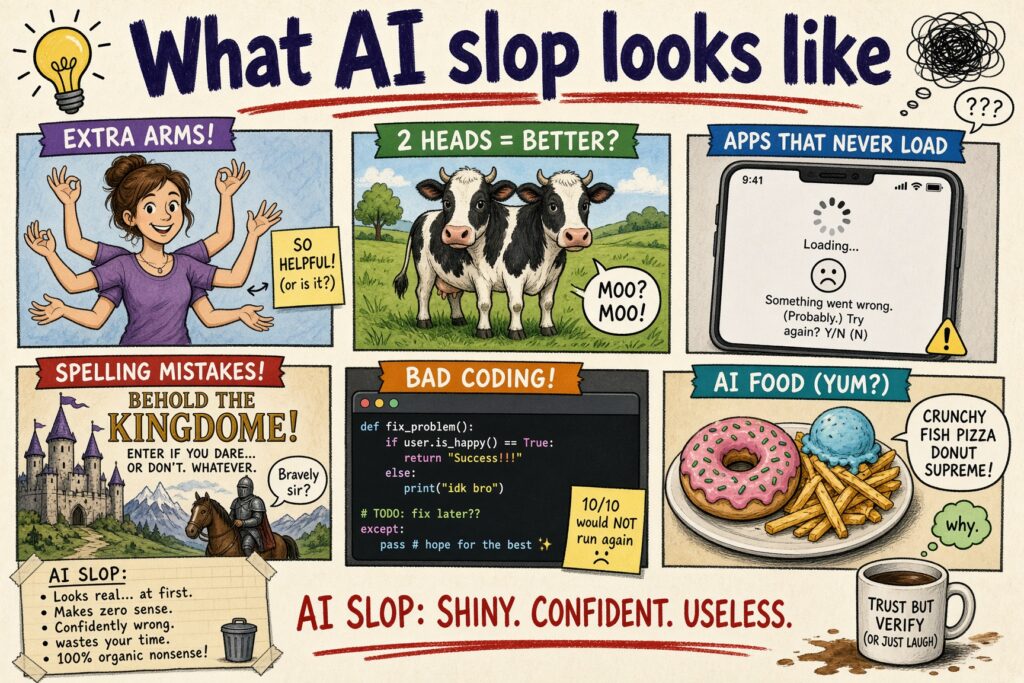
Design: extra fingers, broken text, fuzzy edges, uneven curves, files that cannot go to a printer.
Writing: repetitive sentences, awkward structure, generic language, missing personality and invented facts.
Video: strange faces, wrong shadows, objects that jump and robotic voiceovers.
Code: an app that “works” until login, payments or real users appear — and the person who built it cannot explain the code.
From a distance it looks finished, but up close it is often unusable.
Cleaning AI is now a real freelance job
In September 2026, The Guardian reported a sharp rise in work that exists to fix AI output.
On Freelancer.com, job listings containing phrases such as “correct AI”, “AI hallucination” or “AI error” rose 87% to 10,760 globally between August 2025 and June 2026, according to internal data shared with the paper. Most of those jobs were in graphic design, followed by video editing, proofreading and writing.
Upwork reported a 70% year-on-year rise in AI remediation gigs. Fiverr said searches for “AI cleanup” grew more than 20 times between 2023 and 2026.
That does not mean every freelancer is getting rich from AI slop cleanup. It does mean businesses are paying for it at a scale large enough to show up in marketplace data.
You can see the same job sold as a product. On Zinn Hub, one listing offers to vectorise and fix AI-generated logos by hand — broken lines, uneven curves, duplicate shapes and wrong text — so the file can actually be used. Another offers to fix AI art, AI logos and other generated-image problems.
What AI cleanup work looks like
A graphic designer in Spain told The Guardian that by 2025, about 90% of her logo and packaging requests were AI cleanup, and that work was 60% to 70% of her income. Some files were so poor she had to start again. Clients still wanted to pay less. She began turning jobs down. She called the work soulless.
An illustrator in Florida was offered about $500 to repair 13 to 15 AI pictures for a children’s book. The client thought each image would take 15 minutes. He said no. His rate is $65 an hour, and he said the real work can take hours or days.
Writer and editor Kym Dunbar, in Australia, said AI cleanup is now about 60% of her workload. She has cleaned generated books, long articles and technical papers: repetitive language, clumsy structure and that empty feeling AI prose often has. Original writing jobs have been harder to find.
Video editors are doing the same job in motion. Nathan McConnell, a freelancer interviewed by The Guardian, described removing reflections from AI-generated property videos, replacing robotic voiceovers and fixing malformed 3D. He was also asked to repair about 100 AI-generated tarot cards, at two to three hours each, and stopped after the first 10. Some of it, he said, cannot be saved.
“Cleanup” makes the job sound smaller than it is.
Vibe coders are a big part of this
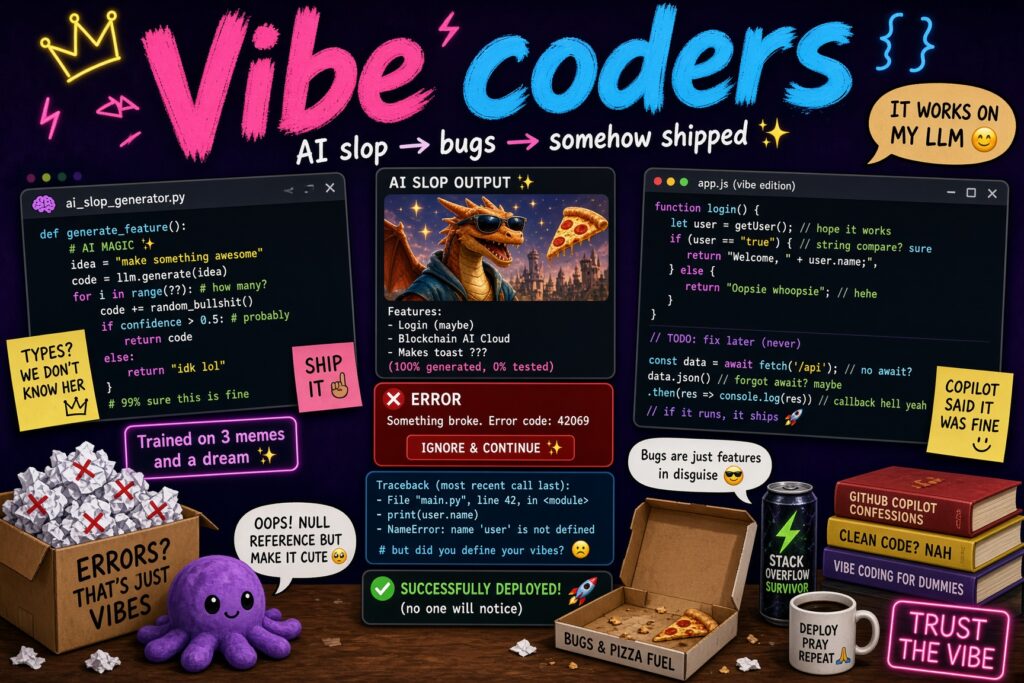
Then there is vibe coding: describing an app in plain English and letting Cursor, Lovable, Bolt, Replit or v0 write the software. Many people never read the code.
The demo looks great. Then a customer tries to sign up, or pay, or reset a password. Something breaks. The builder pastes the error back into the AI. The AI “fixes” it, and sometimes breaks something else.
They cannot repair it themselves because they do not understand what they made. So they hire a developer: “I built this in Lovable. Login is broken. Please fix.”
That is AI slop cleanup too.
The developer reads the repo, deletes the junk and tries to make the app safe enough for real users. Sometimes the honest answer is not a patch. It is to rebuild the broken part properly.
There are already freelance services on marketplaces offering to fix and finish vibe-coded applications.
Why clients think AI Cleanup should be cheap
The client already paid for the AI. In their head, the hard part is done. They believe that the freelancer is only tidying up.
However, that is often a very wrong assumption.
Cleaning AI slop can take as long as making the thing properly. In fact, sometimes longer, because you are stuck with mistakes you did not choose.
The first draft was cheap. The judgement needed to make it usable is not.
Freelancers across design, writing, illustration and video told The Guardian the same thing: clients expect the work to be quick and inexpensive. It often is not.
AI took some work away too
AI cleanup is growing at the same time some original freelance work has shrunk.
A 2025 Management Science study by Ozge Demirci, Jonas Hannane and Xinrong Zhu found that, within eight months of ChatGPT’s launch, job posts for automation-prone writing and coding work fell 21% compared with more manual jobs. After image generators arrived, image-creation posts fell 17%. The jobs that remained in those categories tended to be more complex and better paid.
So AI has not simply destroyed freelance work. It has changed the brief.
Some work disappeared. Some got harder. And a new job appeared:
Make the AI version usable.
How to sell the skill without getting cheapened
Some freelancers take the work because the jobs are there. Some hate it and a few like the puzzle.
The people who treat it as a real service, not a favour, do this:
- Look at the files before you quote.
- Do not agree to “15 minutes a picture” without seeing the pictures.
- Say what you will repair, rebuild or refuse.
- On apps, check logins, payments and security first.
- If the mess is too big for the budget, say so.
A good freelancer should be willing to tell a client that something cannot be saved.
Sometimes rebuilding from scratch is the better option.
Is AI slop cleanup a skill worth building in 2026?
Yes — as a skill, not as a whole career.
The demand is real. Marketplace data shows it! Freelancers’ inboxes show it.
But AI will get better at first drafts, and the cheapest cleanup — extra fingers, obvious ChatGPT cadence and other simple corrections — will become less valuable.
The part that lasts is not “I fix slop.”
It is knowing why something is wrong.
A designer who understands branding, typography and print.
A writer who can fact-check, structure and make a sentence sound like a person.
A developer who understands authentication, data and what must never be left in the frontend.
AI can produce the first version.
The freelancer is still responsible for the version that ships.
The simple version
AI made the first draft easy. It did not make the finished thing easy.
The new freelance brief is often not:
“Make me a logo.”
or
“Build me an app.”
It is:
“Someone already made this with AI. It is a mess. Can you fix it?”
That is AI slop cleanup.
In 2026, a lot of freelancers are spending their week doing exactly that.
Where the facts come from
Freelance-market figures are from Aaron Mok, “Freelancers are getting buried with ‘soulless’ AI slop cleanup,” published by The Guardian on 2 September 2026. The article cites data shared by Freelancer.com, Upwork and Fiverr and includes interviews with freelancers including Kym Dunbar.
The decline in some writing, coding and image-creation jobs comes from Ozge Demirci, Jonas Hannane and Xinrong Zhu, “Who Is AI Replacing? The Impact of Generative AI on Online Freelancing Platforms,” published in Management Science in 2025.
The Zinn Hub examples are live listings for AI logo and image cleanup on Zinn Hub.