Buy Technical SEO Audit & Optimisation Services
Technical SEO is the foundation that determines whether search engines can properly crawl, index, render, and rank your website. Without a technically sound site, even the best content and strongest backlinks cannot perform to their potential. Technical SEO services cover everything from site speed optimisation and Core Web Vitals fixes to crawlability improvements, indexation management, structured data implementation, and JavaScript rendering solutions. If Google cannot efficiently access and understand your pages, your rankings suffer — and most site owners never realise technical issues are the cause.
On Zinn Hub, verified technical SEO professionals offer comprehensive audit and optimisation services using industry-leading tools like Screaming Frog, Sitebulb, DeepCrawl, and Google Search Console. No guesswork, no generic checklists — just thorough, data-driven technical SEO analysis with prioritised recommendations and hands-on implementation. Whether you need a one-off audit to identify what is holding your site back, a full implementation to fix critical issues, or ongoing monitoring to keep your technical foundation strong, Zinn Hub connects you with experienced providers who deliver measurable, actionable results.
Why Technical SEO Is So Important
The reason technical SEO is so critical comes down to a simple truth — Google can only rank pages it can find, crawl, and understand. If your site has crawl errors blocking important pages, slow load times pushing Core Web Vitals into the red, broken canonical tags splitting authority across duplicate URLs, or JavaScript-dependent content that Google cannot render properly, your rankings will suffer regardless of your content quality or backlink profile. Technical issues are often invisible to site visitors but devastating to search performance.
Technical SEO problems are also cumulative. A few redirect chains, some orphaned pages, a handful of crawl errors, and a slightly slow server response time may each seem minor individually — but combined they can significantly reduce your site's crawl efficiency, indexation rate, and ranking potential. A professional technical SEO audit identifies all of these issues, quantifies their impact, and provides a clear roadmap for fixing them in priority order.
Types of Technical SEO Services on Zinn Hub
- Technical SEO Audit (Full Site) — A comprehensive crawl and analysis of your entire website covering crawlability, indexation, URL structure, redirects, canonical tags, site speed, Core Web Vitals, mobile usability, structured data, JavaScript rendering, and internal linking architecture. Delivered as a prioritised report with specific fixes and expected impact for each issue.
- Core Web Vitals Optimisation — Focused service targeting Largest Contentful Paint, Interaction to Next Paint, and Cumulative Layout Shift scores. Includes image optimisation, JavaScript deferral, CSS optimisation, server response improvements, and render-blocking resource elimination. Designed to bring all pages into Google's "good" threshold for page experience signals.
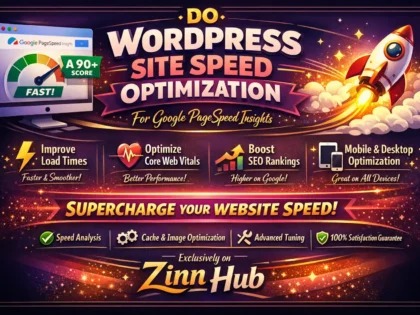
- Site Speed Optimisation — Performance-focused service covering server response time, caching configuration, CDN setup, image compression and next-gen format conversion, code minification, lazy loading implementation, and database optimisation. Targets measurable improvements in page load time and Lighthouse performance scores.
- Crawl Budget Optimisation — Analysis and optimisation of how search engines allocate crawl resources to your site. Includes robots.txt refinement, XML sitemap optimisation, removal of low-value URLs from crawl paths, redirect chain resolution, and internal linking improvements to direct crawl priority toward your most important pages.
- Schema Markup & Structured Data — Implementation of JSON-LD structured data across your site including Organization, LocalBusiness, Service, Product, FAQPage, HowTo, BreadcrumbList, Article, and Review schema types. Enables rich results in search and helps Google understand your content more precisely.
- JavaScript SEO & Rendering Fixes — Specialist service for sites built on JavaScript frameworks like React, Angular, Vue, or Next.js. Includes rendering analysis, server-side rendering implementation, pre-rendering solutions, and ensuring all critical content is accessible to search engine crawlers without relying on client-side JavaScript execution.
- Site Migration SEO Support — Technical SEO planning and execution for platform migrations, domain changes, URL restructures, HTTPS migrations, and redesign launches. Includes redirect mapping, pre-migration auditing, post-migration monitoring, and indexation tracking to minimise ranking disruption during transitions.
- Ongoing Technical SEO Monitoring — Monthly monitoring covering crawl health, indexation status, Core Web Vitals, server errors, new technical issues, and ranking impact analysis. Includes regular reporting and proactive fixes to maintain a strong technical foundation as your site evolves and grows.
How to Evaluate Technical SEO Service Quality
Not all technical SEO services are equal. The value of a technical audit depends on the depth of analysis, the tools and methodology used, whether the provider examines server logs and rendering alongside standard crawl data, the clarity and prioritisation of the recommendations, and whether the report provides specific actionable fixes rather than generic best practice lists. A quality audit identifies issues you did not know existed and quantifies their ranking impact — not just ticks boxes from a template checklist.
When reviewing technical SEO providers on Zinn Hub, look for sellers who explain their audit methodology, who use professional crawl tools rather than free online scanners, who provide prioritised recommendations ranked by impact and effort, and who can demonstrate experience with sites of similar size and complexity to yours. Avoid providers who deliver generic reports with no site-specific analysis or who cannot explain the tools and processes they use. A strong technical audit is an investment that pays for itself many times over in recovered and improved rankings.
Building a Complete SEO Strategy
Technical SEO is one pillar of a complete search strategy. Combine technical optimisation with other SEO services for maximum impact. Browse the full range of SEO and digital marketing services on the technical SEO marketplace and the digital marketing marketplace.
Are you a technical SEO specialist with proven audit and implementation experience? Start selling technical SEO services on Zinn Hub and connect with site owners worldwide who need expert technical analysis. Register as a Zinner for free and start listing today.
How to Buy Technical SEO Audit & Optimisation Services
Identify Your Technical SEO Needs Review Google Search Console for crawl errors, indexation issues, Core Web Vitals warnings, and mobile usability problems. Check site speed scores in PageSpeed Insights. Note any recent ranking drops, site changes, or migrations that may have introduced technical issues.
Browse Technical SEO Providers Review seller profiles, audit samples, and buyer reviews on Zinn Hub. Compare providers on audit depth, tools used, JavaScript and structured data coverage, turnaround time, and whether they offer implementation alongside the audit. Look for prioritised action plans with clear fixes.
Share Your Site Details and Order Provide your website URL, CMS platform, approximate page count, known issues, and Google Search Console access if required. Discuss whether you need audit only or audit plus implementation. Share any recent site changes relevant to the audit scope.
Review Audit and Implement Fixes Review the audit report and prioritised recommendations. Verify fixes using Google Search Console and crawl tools. Monitor indexation, crawl stats, Core Web Vitals, and ranking changes over 4-8 weeks. Use the audit as a baseline for ongoing technical SEO monitoring.
Frequently Asked Questions About Technical SEO Services
What is technical SEO and why does it matter?+
Technical SEO covers everything that affects how search engines crawl, index, render, and understand your website. It includes site speed, mobile responsiveness, crawlability, URL structure, XML sitemaps, robots.txt configuration, structured data, HTTPS security, canonical tags, hreflang for international sites, and Core Web Vitals. It matters because even the best content and strongest backlinks cannot rank if Google cannot properly access, crawl, and index your pages. Technical SEO is the foundation that makes all other SEO efforts effective. A technically broken site wastes crawl budget, loses indexation, and bleeds ranking potential — regardless of how good the content is.
What does a technical SEO audit include?+
A comprehensive technical SEO audit typically covers crawlability analysis including robots.txt, XML sitemaps, and internal linking structure. It examines indexation status across all key pages, identifies duplicate content and canonical tag issues, reviews URL structure and redirect chains, tests site speed and Core Web Vitals performance, checks mobile usability and responsive rendering, audits structured data and schema markup implementation, verifies HTTPS configuration and mixed content issues, analyses JavaScript rendering for search engines, reviews server response codes and error pages, and checks hreflang implementation for multilingual sites. The audit delivers a prioritised list of issues with specific fixes ranked by impact on search performance.
How much do technical SEO services cost?+
Technical SEO service prices on Zinn Hub vary based on the scope of work, the size and complexity of your website, and the depth of the audit or implementation required. A basic technical SEO audit for a small site with under 500 pages typically costs $100-300. Comprehensive audits for medium sites with 500-5,000 pages range from $250-600. Enterprise-level audits for large sites with complex architecture, JavaScript rendering, or international setups cost $500-1,500 or more. Implementation services — where the provider fixes the issues rather than just identifying them — are priced separately and depend on the volume and complexity of fixes required. Some providers offer combined audit-and-fix packages for better value.
What are Core Web Vitals and how do they affect rankings?+
Core Web Vitals are a set of specific page experience metrics that Google uses as ranking signals. The three core metrics are Largest Contentful Paint (LCP) which measures how quickly the main content of a page loads and should be under 2.5 seconds, Interaction to Next Paint (INP) which measures how quickly a page responds to user interactions and should be under 200 milliseconds, and Cumulative Layout Shift (CLS) which measures visual stability and how much the page layout shifts during loading and should be under 0.1. Poor Core Web Vitals scores can suppress rankings, particularly on mobile where Google uses mobile-first indexing. Fixing Core Web Vitals issues often involves optimising images, reducing JavaScript execution time, improving server response times, and implementing proper element sizing.
What is crawl budget and why should I care about it?+
Crawl budget is the number of pages Google will crawl on your site within a given time period. For small sites with fewer than a few thousand pages, crawl budget is rarely an issue — Google can crawl your entire site easily. For larger sites with tens of thousands or millions of pages, crawl budget becomes critical because Google may not crawl all your pages frequently enough to discover new content or pick up changes. Wasted crawl budget on low-value pages like filtered URLs, paginated archives, parameter-heavy URLs, or duplicate content means your important pages get crawled less often. Technical SEO services that optimise crawl budget focus on blocking low-value pages in robots.txt, fixing redirect chains, consolidating duplicate content, improving internal linking to priority pages, and ensuring XML sitemaps only include indexable URLs.
How often should I run a technical SEO audit?+
For most websites, a comprehensive technical SEO audit should be run at least every 6-12 months to catch issues that develop over time as content is added, plugins are updated, and the site evolves. However, you should run an immediate audit after any major site change — a redesign, platform migration, URL restructure, new CMS deployment, or significant content reorganisation. Sites that publish content frequently or have large, complex architectures benefit from quarterly audits or continuous monitoring. Many technical SEO providers on Zinn Hub offer ongoing monthly monitoring services that catch issues in real time rather than waiting for a periodic audit to discover problems that may have been hurting rankings for months.
What is the difference between technical SEO and on-page SEO?+
Technical SEO focuses on the infrastructure and architecture of your website — how search engines access, crawl, render, and index your pages. It deals with server configuration, site speed, crawlability, indexation, URL structure, schema markup, and Core Web Vitals. On-page SEO focuses on the content and HTML elements of individual pages — title tags, meta descriptions, heading structure, keyword usage, internal linking, image alt text, and content quality. Both are essential and complementary. Technical SEO ensures Google can find and process your pages correctly. On-page SEO ensures the content on those pages is relevant, optimised, and competitive for your target keywords. A technically perfect site with poor content will not rank, and perfectly optimised content on a technically broken site will not rank either.
Can technical SEO issues cause a drop in rankings?+
Yes. Technical SEO issues are one of the most common causes of sudden or gradual ranking drops. A misconfigured robots.txt file can block Google from crawling important pages. Broken canonical tags can split ranking signals across duplicate URLs. Slow page speed can push you below Core Web Vitals thresholds. A faulty redirect can send link equity into a dead end. An accidental noindex tag can remove pages from Google entirely. Server errors and downtime can cause Google to deprioritise your site. The danger with technical issues is that they often go unnoticed because the site looks fine to visitors — the problems are invisible unless you are actively monitoring crawl data, indexation status, and server logs. Regular technical audits catch these issues before they cause lasting damage.
What is JavaScript rendering and why does it matter for SEO?+
JavaScript rendering refers to how search engines process and understand content that is generated by JavaScript rather than being present in the initial HTML source code. Many modern websites use JavaScript frameworks like React, Angular, Vue, or Next.js to build their pages, meaning the content only appears after JavaScript executes. Google can render JavaScript, but it does so in a separate phase that can be delayed by hours or days — meaning JavaScript-dependent content may not be indexed as quickly or reliably as server-rendered HTML. If critical content, internal links, or metadata depend on JavaScript execution, there is a risk that Google may not see them properly. Technical SEO services that address JavaScript rendering typically involve implementing server-side rendering, pre-rendering, or dynamic rendering to ensure search engines receive fully rendered content without relying on client-side JavaScript.
How do I know if my site has technical SEO problems?+
The most reliable indicators of technical SEO problems include pages dropping out of Google index without explanation, Google Search Console showing crawl errors or coverage issues, slow page speed scores in PageSpeed Insights or Lighthouse, mobile usability errors in Google Search Console, significant gaps between the number of pages on your site and the number indexed by Google, ranking drops that do not correspond to content or link changes, and search console reports showing increasing soft 404 or server errors. For a definitive answer, a professional technical SEO audit using crawl tools like Screaming Frog, Sitebulb, or DeepCrawl combined with Google Search Console data and server log analysis will identify every technical issue affecting your site and prioritise them by impact.
What is structured data and does my site need it?+
Structured data is code added to your website in a format like JSON-LD that helps search engines understand the content on your pages more precisely. It uses a standardised vocabulary from Schema.org to explicitly tell Google what a page is about — whether it is a product, a service, a FAQ, a how-to guide, a review, an event, a recipe, a local business, or hundreds of other content types. While structured data is not a direct ranking factor, it enables rich results in search — enhanced listings with star ratings, prices, FAQ dropdowns, how-to steps, breadcrumbs, and other visual elements that significantly increase click-through rates. For most business websites, implementing at minimum Organization, LocalBusiness, Service, FAQPage, and BreadcrumbList schema is recommended. Ecommerce sites should add Product, Offer, and AggregateRating schema.
Can technical SEO help a slow website rank better?+
Yes. Site speed is both a direct ranking factor and a major influence on user experience signals that affect rankings. A slow website increases bounce rate, reduces time on site, and frustrates users — all signals that Google interprets as poor quality. Technical SEO services that improve site speed typically address image optimisation and next-gen formats like WebP and AVIF, JavaScript and CSS minification and deferral, server response time and hosting performance, browser caching and CDN configuration, render-blocking resource elimination, lazy loading for images and videos, and database query optimisation. Improving page load time from 5 seconds to under 2.5 seconds can produce measurable ranking improvements, particularly on mobile where Google applies mobile-first indexing and where slow connections amplify the impact of poor optimisation.



 ✓
✓ ✓
✓ ✓
✓ ✓
✓ ✓
✓ ✓
✓ ✓
✓