


Table of Contents
Why Every Freelancer Needs Communication and Customer Service Skills is the competitive advantages most freelancers ignore. Clear communication builds trust, and trust wins repeat work. The difference between a freelancer who thrives and one who merely survives often comes down to something surprisingly simple – how well they communicate and treat their clients!
You might be the most talented designer, developer, or writer in your field. Your portfolio could make competitors weep with envy. But if you ghost clients for days, respond to briefs with “Yeah, ok, I’ll sort it later,” or treat feedback like a personal attack, you’ll find yourself wondering why the work has dried up whilst someone half as skilled is fully booked until next summer.
Here’s the uncomfortable truth I quickly learnt in my early years of being a freelancer. And after years of working with clients on both sides of the fence; they don’t just pay for work – they pay for certainty.
Talent Gets You Hired But Certainty Gets You Rehired
Technical ability matters, but it’s no longer the differentiator it once was. When a client can choose between fifty developers who can all build their website, they’re going to pick the one who actually responds to emails within a reasonable timeframe.

Most clients hire freelancers for two reasons: they need your expertise, and they want the work handled without having to chase, manage, or second-guess every step. So when you disappear for three days, send vague updates like “nearly done”, or reply with a one-word “ok” (which carries legendary levels of menace, by the way), you’re accidentally giving them the one thing they were trying to avoid: uncertainty.
Great customer service in freelancing terms is beautifully simple: make the client feel safe, informed, and looked after. Just reliable, dependable and professional.
What Good Freelancer Communication Looks Like
Let’s get specific, because “communicate better” is about as useful as advice gets. The standard that wins work in almost every industry comes down to five things:
- Active listening (so you don’t build the wrong thing)
- Summarise what you heard: “Just to confirm, you want X because Y…”
- Ask clarifying questions early, not halfway through delivery
- Confirm priorities and success criteria before you start
- Clarity and conciseness (so clients don’t have to decode you)
- Get to the point and use simple language
- Use bullets and short paragraphs for skimmability
- End messages with a clear next step and deadline
- Fast acknowledgement (so clients feel looked after)
- Acknowledge messages the same working day
- If you can’t reply fully, give a specific time you will
- Even a short “Got it – back to you by tomorrow 3pm” reduces anxiety
- Expectation-setting and predictable updates (so there are no surprises)
- Agree deliverables, timeline, review points, and what “done” means
- Set boundaries: what’s in scope, what’s extra, and how changes are handled
- Provide regular updates using “Done / Next / Blocked / ETA”
- Empathy and confident professionalism (especially when things get tense)
- Show you understand pressure on their side: “I know this is time-sensitive…”
- Keep your tone calm and solutions-focused when problems appear
- Be confident without arrogance: offer options, make recommendations, follow through

Good communication doesn’t mean being available 24/7. It means setting expectations, giving clear updates, and following through. Good communication is not constant communication – it’s structured communication.
Responding promptly doesn’t mean being chained to your inbox around the clock. It means setting realistic expectations and meeting them. Aim to acknowledge every message within the same working day, even if you can’t act on it yet. You don’t need a full answer immediately; you need a signal.
Instead of leaving a client hanging, try: “Thanks – got this. I’m tied up until this afternoon, but I’ll review and come back with a plan by 3pm tomorrow.” That last bit matters: a specific time. Not “soon.” Not “ASAP.” An actual time!
Being clear and thorough saves everyone time. When you send a project update, include what you’ve done, what’s next, and whether you need anything from them. Don’t make clients chase you for basic information. A two-minute email now prevents a fifteen-minute phone call later.
Managing expectations proactively is where many freelancers fall down spectacularly. If a deadline is slipping, say so immediately – not the day before it’s due. If a request is outside the project scope, explain that clearly and professionally, with options for how to proceed. Clients can handle bad news; what they can’t handle are surprises that derail their own planning.
The Update Format That Changes Everything
Clients are busy. They don’t want a novel. They want certainty in under ten seconds from the freelancer they hire.
Use this format for project updates: Done / Next / Blocked / ETA
For example:
- Done: Homepage draft v1, headline options
- Next: Refine sections 2-4, add testimonials
- Blocked: Need your choice on headline A or B
- ETA: Friday 2pm
That’s customer service. That’s also project management. And yes, you can charge more for it. When clients know exactly where things stand without having to ask, they relax. They trust you, and they come back.
The Ripple Effect of Poor Communication and Customer Service Skills
Consider this scenario: a client sends you a project brief on Monday morning. You’re busy, so you don’t respond until Wednesday afternoon with a few clarifying questions. They answer Thursday. You go quiet again. By the following week, they’ve heard nothing and have no idea whether the project has started, whether you understood their requirements, or whether you’re even still interested.
From your perspective, you’ve been working away diligently. From theirs, you’ve disappeared into a void, leaving them anxious and uncertain. Even if you deliver stunning work, the relationship has been damaged. They’ve spent a week feeling ignored, and that emotional experience will colour everything that follows.
Now imagine the alternative: you respond Monday afternoon confirming receipt, outline your understanding of the brief, ask your clarifying questions, and provide a rough timeline. The client immediately feels confident they’ve made the right choice. Trust builds from the first interaction, and that trust becomes the foundation for a productive working relationship.
Scripts for Sticky Situations
You can be friendly and human and still run a tight ship. Here are templates for the moments that trip most freelancers up.
When you’re running behind (without sounding flaky):
“Quick heads-up: I’m running [reason] behind. The new delivery time is [day/time]. If that affects anything on your side, let me know the priority, and I’ll adjust.”
When the brief is unclear (without blaming the client):
“Before I build the wrong thing confidently, can you confirm one decision: are we optimising for A or B?”
When scope creeps (without starting a war):
“Happy to add that – it’s outside the original scope. Two options: swap it with X, or add £[amount] and [timeframe]. Which works better for you?”
When you need feedback (and don’t want to chase forever):
“When you get a moment, can you review [link] and reply with either ‘approved’ or a bullet list of changes by [date]?”
When you disagree (and want to stay professional):
“I see why you’d want that. My concern is [impact]. I’d recommend [option] because [reason]. Would you like me to mock both quickly so you can compare?”
Common Mistakes and Better Alternatives
1. Mistake: “Just checking in…”
Better: Ask for a decision with a deadline. “Can you confirm A or B by Wednesday 2pm so I can hit Friday delivery?”
2. Mistake: “Nearly done”
Better: Say what’s done and what’s left. “The draft is complete. I’m now polishing sections 3-5 and adding examples. Sending at 4pm.”
3. Mistake: Replying emotionally to stressful messages
Better: Respond to the problem, not the tone. “Understood. Here’s what I can do today, what I need from you, and when you’ll have the next version.”
4. Mistake: Being too “nice” to set boundaries
Better: Be clear and warm. “Happy to help – here are the two options and what each costs.”
Polite clarity beats polite vagueness every time.
Building Long-Term Client Relationships
The maths of freelancing heavily favours retention over acquisition. Finding new clients requires digital marketing, proposals, negotiations, and all the uncertainty of working with someone for the first time. Existing clients who trust you will return again and again, often with bigger projects and better budgets. They’ll refer you to colleagues. They’ll write glowing testimonials. They become, in effect, an unpaid sales team working on your behalf.

However, this only happens when clients genuinely enjoy working with you! Technical competence gets your foot in the door; communication and service keep you there.
Simple things make an enormous difference. Remembering details about a client’s business or preferences. Checking in after a project launches to see how it’s performing. Thanking them for the work opportunity. Sending a brief message when you see something relevant to their industry. These touches take minimal effort but create maximum impact because they demonstrate something increasingly rare: you actually care.
Going Beyond Good to Great: The Flywheel Effect
There’s a meaningful difference between meeting expectations and exceeding them. Good customer service keeps clients satisfied. Great customer service turns them into advocates.
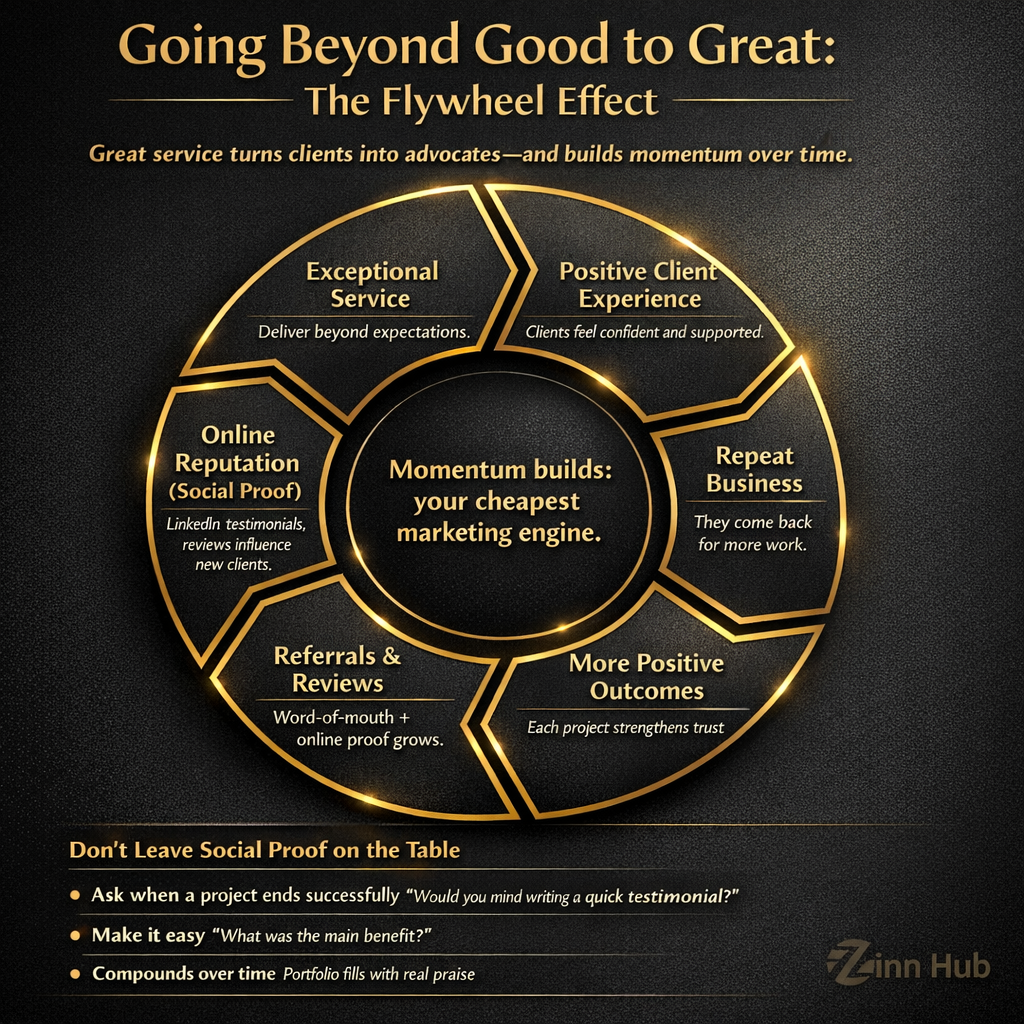
This creates what’s known as the flywheel effect: exceptional service leads to positive experiences, which generate repeat business, which create more positive experiences, which spark referrals and reviews – and the momentum builds on itself. Once spinning, this flywheel becomes your most powerful (and cheapest) marketing engine.
Here’s the thing most freelancers miss: in an era where potential clients search your name before making contact, your online reputation matters enormously. Reviews, testimonials, and social proof have become essential decision-making tools. Someone considering hiring you will check your LinkedIn recommendations and look for evidence that others have had positive experiences working with you.
Yet most freelancers never ask for testimonials. They finish a project, send the invoice, and move on – leaving all that potential social proof on the table.
Don’t be passive about this. When a project wraps up successfully, ask. A simple “Would you mind writing a quick testimonial I could use on my website?” or “If you were happy with the work, I’d really appreciate a recommendation on LinkedIn” is all it takes. Most satisfied clients are happy to help; they just need prompting.
Better still, make it easy for them. Offer to draft something they can edit, or ask a specific question like, “What was the main benefit of working together?” People find it much easier to respond to a prompt than to write from a blank page.
These testimonials compound over time. A year from now, you could have a portfolio page filled with genuine client praise – or you could have nothing. The only difference is whether you asked.
The Simple Operating System
You don’t need six apps and a second brain. You just need consistency.
One phone rule. If you miss a call, return it the same working day – even if it’s just to say you’ll call back properly tomorrow. Unanswered voicemails feel like being ignored. A quick callback, even a short one, shows you’re on it.
One place where decisions live. A shared doc, an email thread, a project board – anything, as long as it’s one place where both you and the client can reference what was agreed.
One update rhythm. Pick weekly updates every Friday, or twice-weekly for fast-moving projects. Clients relax when they know updates are coming without having to ask.
One intake checklist. Before starting any project, confirm: the goal, the audience, examples of what they like and dislike, assets and access needed, the deadline and key dates, how success will be measured, and who has final sign-off.
One handover process. On delivery, include: all files and links, how to use what you’ve delivered, what to do next, and what support you offer going forward. Don’t just drop a folder like a cat delivering a mouse and expect applause.
Why Communication Is a Freelancer’s Real Competitive Advantage
Most freelancers focus on improving their craft. Designers learn new tools, developers pick up new frameworks, writers study SEO. All worthwhile – but none of it matters if clients don’t enjoy working with you.
Communication is the multiplier. It makes everything else you do more valuable.
Freelancers who communicate well:
Get paid faster. When expectations are clear and updates are regular, there’s no “I thought you meant…” drama at invoice time. The work matches what was agreed, the client’s happy, and payment follows without awkward chasing.
Get better briefs. Because they ask better questions upfront. A five-minute clarification call at the start saves days of rework later. Clients notice when you take the time to truly understand what they need.
Get fewer revision rounds. Because expectations were set clearly from day one. When clients know what they’re getting and when, there are no nasty surprises – and no last-minute “actually, can we change everything” moments.
Get more referrals. Because clients felt looked after, not just served. People remember how you made them feel. A smooth, stress-free project sticks in the mind – and gets mentioned when a colleague asks “know anyone who does X?”
Can raise their rates. Because they’re selling confidence, not just deliverables. Clients will pay more for someone who reduces their stress, communicates proactively, and makes the whole process feel easy. That’s worth a premium.
Here’s what most people get wrong: they think good communication requires being extroverted, or loving networking, or being “always on.” It doesn’t. It requires a repeatable system and the discipline to stick to it. Templates, checklists, and habits beat charisma every time.
Customer service isn’t about being fake-cheerful. It’s about being dependable. It’s about doing what you said you’d do, when you said you’d do it, and keeping people informed along the way.
That’s it! No magic, just good communication!
The 7-Day Challenge
If you want to build better habits, try this for one week:
- Acknowledge every client message the same day it arrives
- End every message with a clear next step and a deadline
- Send at least two “Done / Next / Blocked / ETA” updates
That’s it. Most freelancers won’t do even that. If you do, you’ll stand out immediately – not because you’re louder, but because you’re clearer.
The Competitive Advantage You Control
In an uncertain economy, freelancers worry about things outside their control: budgets, competition, AI tools, market conditions, competition. Valid concerns – but not very actionable.
Communication and customer service, by contrast, are entirely within your control. You can decide today to respond faster, communicate more clearly, and treat every interaction as a chance to demonstrate professionalism. No new tools required. No reinvention. Just doing the basics brilliantly.
The freelancers who thrive won’t always be the most technically gifted. They’ll be the ones clients actually want to work with: responsive, reliable, pleasant, and professional. In a world of talent abundance, being genuinely good to work with never goes out of style.
Your turn as a Freelancer with good communication and customer service skills: Pick one improvement from this post and commit to it for a week. Track what changes – faster approvals, fewer revisions, calmer clients, quicker payments. Small habits compound quickly.
And if you’re a freelancer looking for clients who value professionalism – or a business searching for reliable talent – Zinn Hub helps the two find each other.