
I simulate solute redistribution and interface stability during directional solidification of your material system. You get concentration profiles, enrichment ratio analysis, and publication-quality figures in 3-5 days.

I Will simulate directional solidification and solute redistribution for your material system
Single-condition simulation What you get: • Solute concentration profile for one growth rate • 1 publication-quality figure • Python script for reproduction • Brief interpretation (3-5 sentences) Be
Parameter scan + full analysis What you get: • Solute concentration profiles for 3-5 growth rates • Enrichment ratio vs growth rate curve • Effective partition coefficient analysis • Boundary layer c
Full report + manuscript support What you get: • Everything in Standard • Interface stability analysis (Mullins-Sekerka criterion) • Comparison with literature data • Full methodology appendix • Draf
Request a Custom Offer
Log In to Request a Custom Offer
Create a free account or log in to request a personalised offer from this Zinner.
Log In / RegisterAsk a Pre-Sale Question
Log In to Ask a Question
To reduce platform spam, pre-sale messages can only be sent by logged-in users.
Create a free account or log in to message this Zinner directly.
Log In / RegisterAt a Glance
Key details about this service to help you decide. Generated by Zinn Hub, not the seller.
Value Position
Simulation Method
Output Formats
Best For
Turnaround
What You'll Receive
Full Description
**What you get**
I will simulate solute rejection, concentration profiles, and impurity enrichment during directional solidification of your material system.
Deliverables:
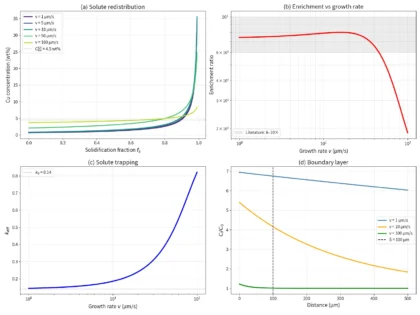
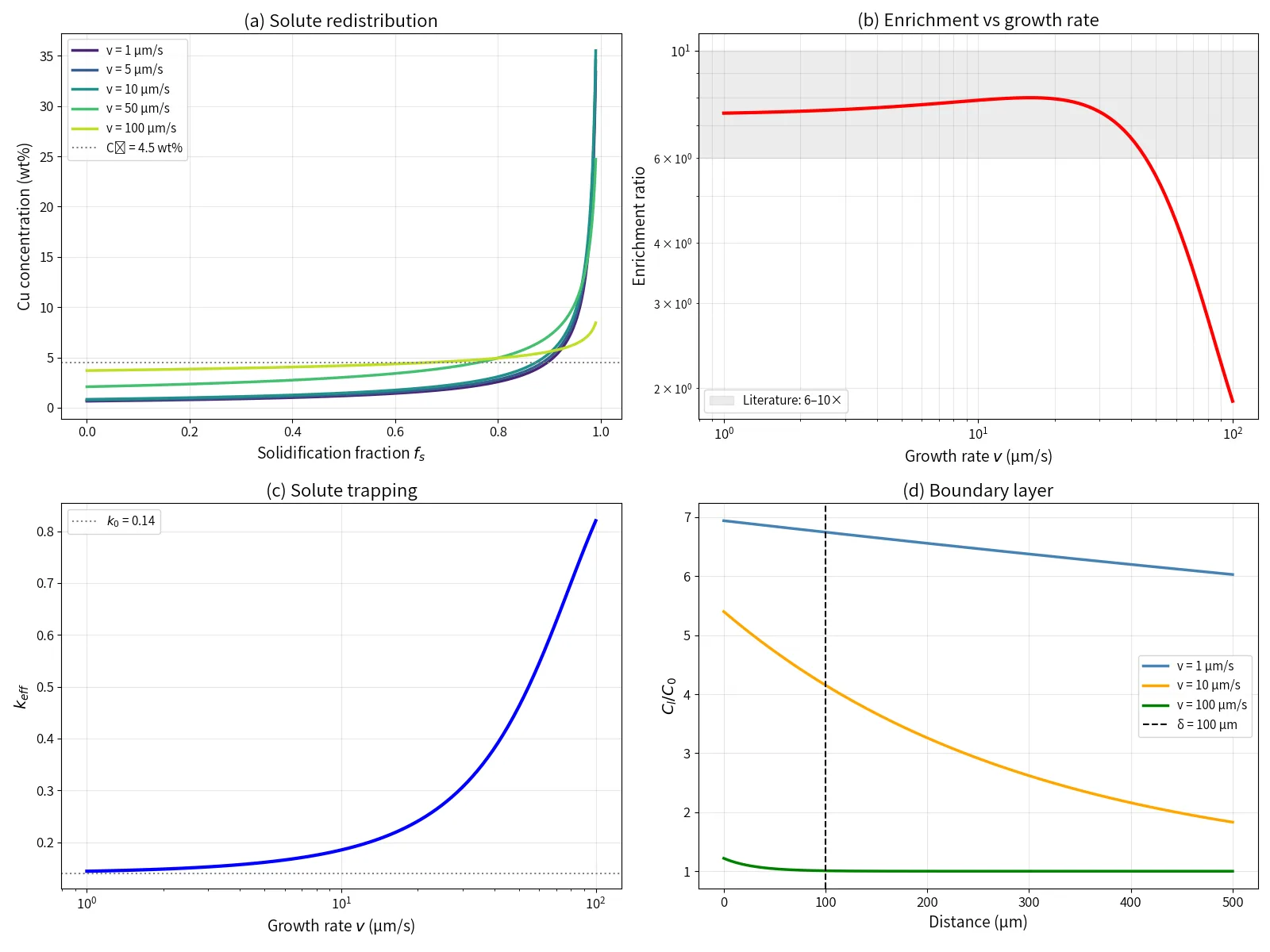
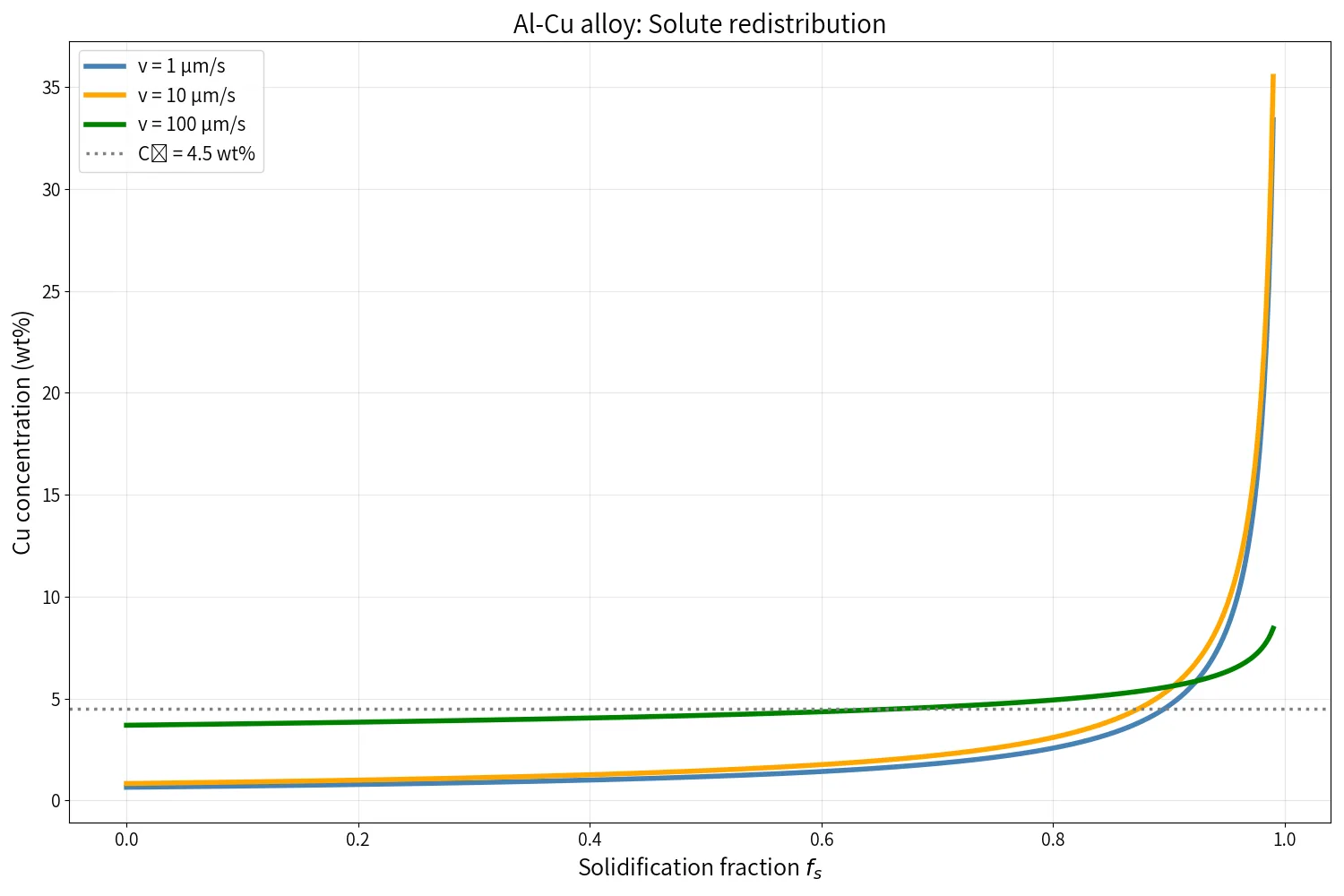
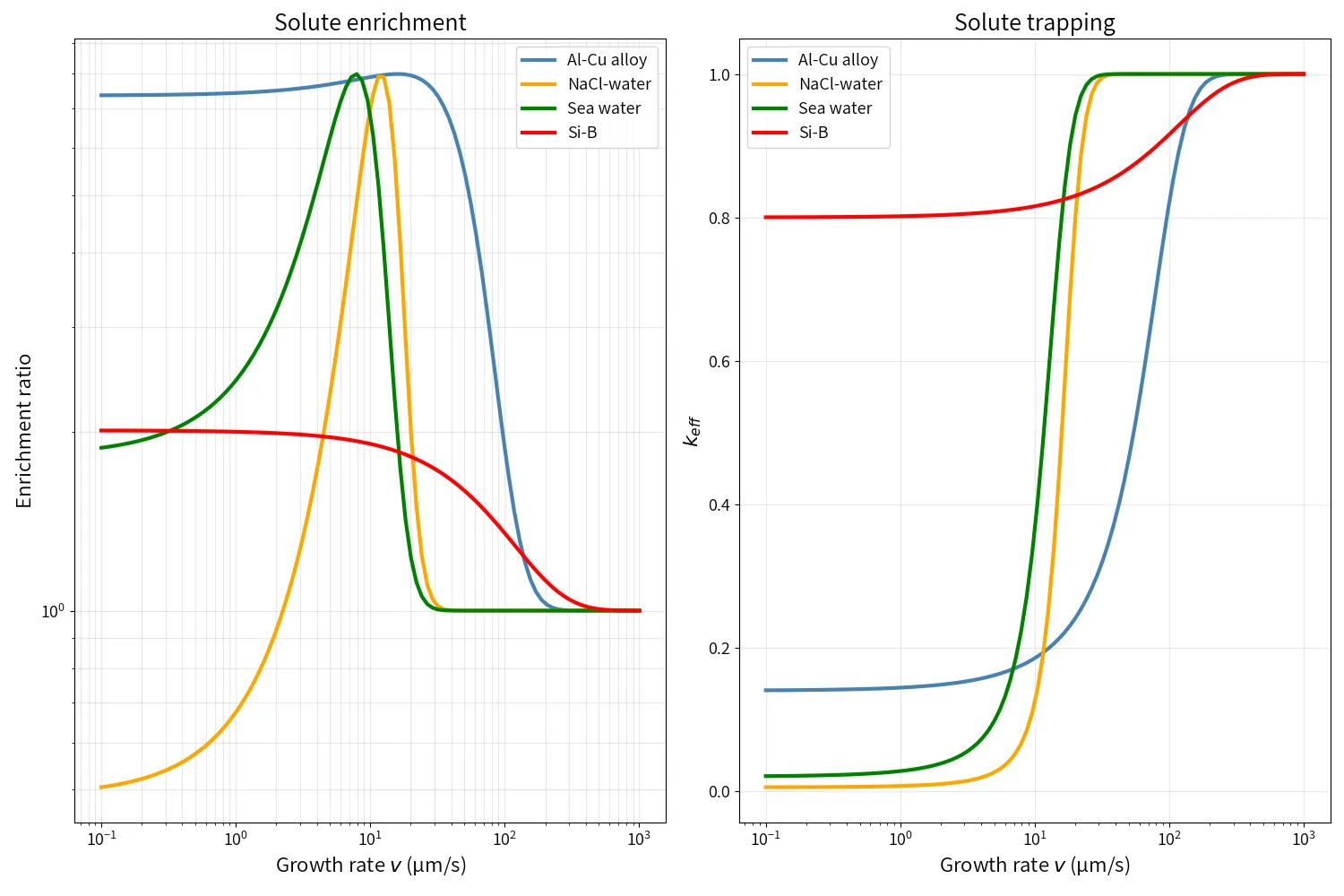
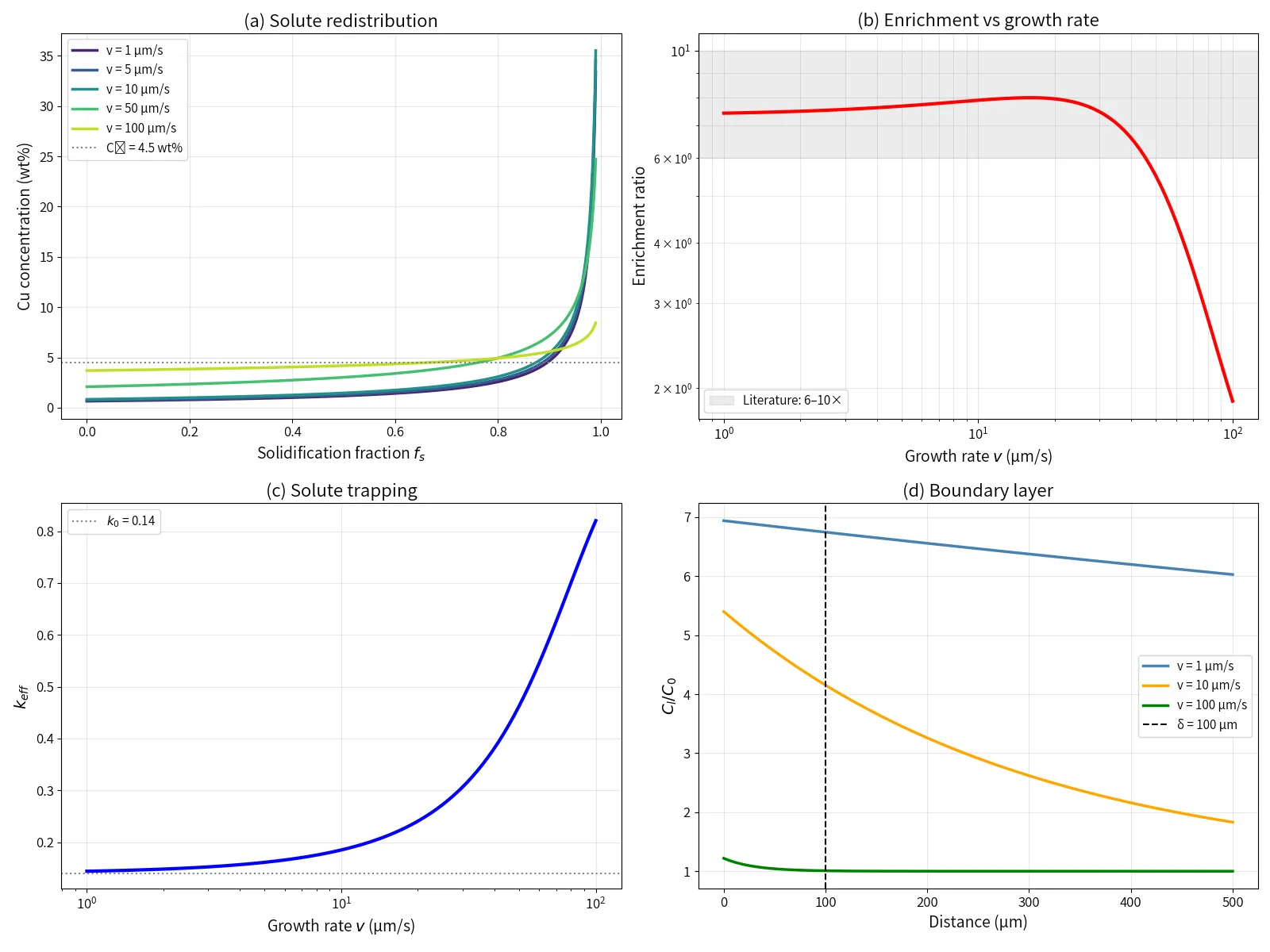
• Solute concentration profile (Scheil equation + BPS effective partition coefficient)
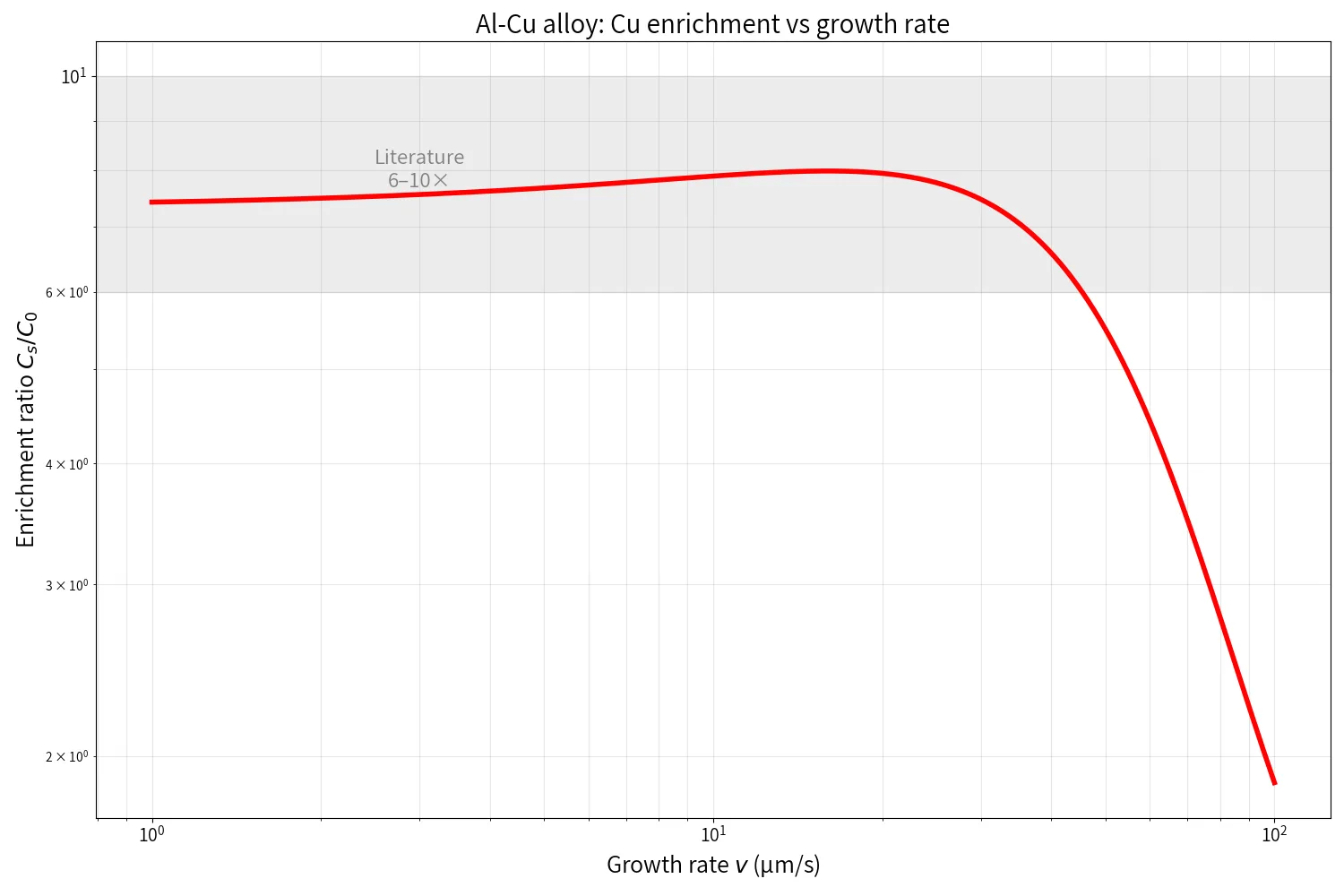
• Enrichment ratio vs solidification rate
• Effective partition coefficient analysis (solute trapping effect)
• Boundary layer concentration profile
• 4 publication-quality figures (PNG/PDF)
• Full Python scripts for reproducibility
**Example output: Al-Cu alloy**
Parameters: k0 = 0.14, C0 = 4.5 wt%, D = 3×10⁻⁹ m²/s
| Growth rate | k_eff | Enrichment ratio |
|---|---|---|
| 1 μm/s | 0.144 | 7.42× |
| 10 μm/s | 0.185 | 7.89× |
| 100 μm/s | 0.820 | 1.88× |
The low-speed enrichment of 7–8× is consistent with published Al-Cu segregation data (6–10×). At high speed, solute trapping suppresses enrichment.
**What I need from you**
• Material system (alloy, ceramic suspension, aqueous solution, etc.)
• Equilibrium partition coefficient k0 (or I can estimate from literature)
• Liquid diffusion coefficient D
• Boundary layer thickness delta (or typical value for your system)
• Range of growth rates to scan
**Delivery**
• 3–5 business days
• Python scripts + figures (PNG/PDF) + brief interpretation report
**Why this works**
The model uses the Burton-Prim-Slichter effective partition coefficient, which captures the competition between interface kinetics (k0) and mass transport (v·delta/D). This is the same competition described by my anchoring framework: the survival factor S = τ_coherence / τ_perturbation determines whether solute is rejected or incorporated.
**My background**
• ORCID: 0009-0008-4540-1381
• Published framework: Zenodo DOI 10.5281/zenodo.22771462
• GitHub: https://github.com/Zsyqdnr
**Disclaimer**
This is an academic analysis. It does not constitute a legally valid engineering assessment for production processes. Results are for research reference only.
**Suitable for**
• Freeze casting / ice templating research
• Progressive freeze concentration (food, pharmaceutical)
• Alloy solidification (Al-Cu, Ni-based superalloys, high-entropy alloys)
• Any material system where solute rejection matters
Zinner Quality Guarantee
Every Zinner is reviewed and approved before joining the platform.
All services are backed by our quality assurance commitment.
Your payment is protected until you approve the delivered work.
Compare Packages
| 特色 | Basic | Standard | Advanced |
|---|---|---|---|
| Delivery Time | 3 days | 5 days | 7 days |
| Revisions | 1 | 2 | Unlimited |
| Solidification rates | 1 | 3-5 | Custom |
| Solute concentration profile | ✓ | ✓ | ✓ |
| Enrichment ratio analysis | ✕ | ✓ | ✓ |
| Effective partition coefficient | ✕ | ✓ | ✓ |
| Boundary layer analysis | ✕ | ✓ | ✓ |
| Number of figures | 1 | 4 | 4 |
| Python scripts | ✕ | ✕ | ✕ |
| Interpretation report | 3–5 sentences | 1–2 pages | Full appendix |
| Interface stability analysis | ✕ | ✕ | ✓ |
| Literature comparison | ✕ | ✕ | ✓ |
| Draft Results paragraph | ✕ | ✕ | ✓ |
| Video call (30 min) | ✕ | ✕ | ✓ |
| Revisions | 1 | 2 | Unlimited |
Portfolio
Examples of the seller's work related to this Zinn.

Anchoring Framework: Zero-Dark-Matter Galaxy Rotation Curves
Published preprint on Zenodo. Fits 159 SPARC galaxies without dark matter. Stellar disks obey Newtonian gravity (k_star ≈ 0); gas disks deviate (k_gas = 0.244/kpc). Cross-validated with THINGS survey.
SRF-SEI Watershed Climate Sensitivity Framework
Published preprint on Zenodo. Identifies four watershed anchor types (snow, mixed, rain, hidden). Validated across 78 US watersheds and 14,406 Chinese mountain grid points.
Python Analysis Code (GitHub)
Reproducible Python code for galaxy rotation curve fitting, watershed analysis, and directional solidification simulation.
Extra Information
My workflow
Tools I use
What I don't do
Service Details
Frequently Asked Questions
Basic package: 3 business days.
Standard package: 5 business days.
Advanced package: 7 business days.
If you need faster delivery, add the "Rush delivery" extra at checkout (+$30, reduces turnaround by 2 days).
Required:
• Material system (e.g., Al-Cu alloy, NaCl-water, sea water)
• Equilibrium partition coefficient k0 (or composition, so I can estimate)
• Liquid diffusion coefficient D (or I can use a typical value)
Optional:
• Boundary layer thickness delta (default: 100 μm for metals, 500 μm for aqueous solutions)
• Growth rate range (default: 1–100 μm/s)
No problem. I can estimate k0 and D from literature for most common alloy systems and aqueous solutions. Just provide the composition (e.g., Al-4.5 wt% Cu) and I will handle the rest.
For uncommon systems, I may need 1–2 extra days to search the literature. No extra charge for standard estimates.
Because this is custom computational work, refunds are not available once the simulation has started.
However, I will:
• Confirm your parameters before starting
• Send you a preview of one figure before final delivery
• Offer one free revision if the output does not match your requested parameters
If you are not satisfied with the initial preview, I can cancel and refund 50%.
Yes. The figures are publication-quality (PNG + PDF, 1500×1000 minimum). You can use them directly in journal manuscripts, theses, or conference presentations.
The Advanced package also includes:
• A draft "Results" paragraph for your manuscript
• A methodology appendix
• Literature comparison
I do not write entire papers, but I provide the modeling, figures, and interpretation you need.
Customer Reviews
See what our customers say about this Zinn