
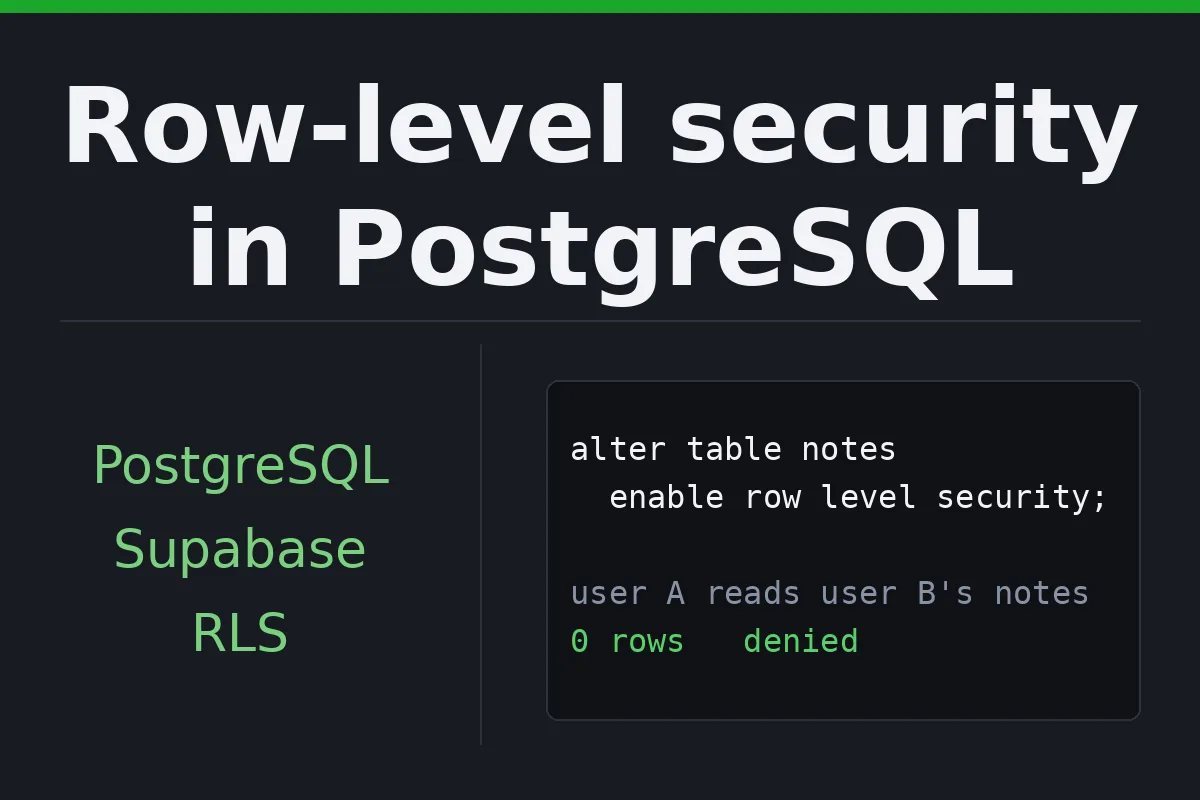
If any logged-in user can read other users' rows, your database is trusting the app to behave. I move the rule into PostgreSQL itself with row-level security policies and roles, then prove with tests that one user cannot reach another user's data.

I Will set up PostgreSQL row-level security so each user sees only their own data, Supabase included
A row-level security review of up to 5 tables, with each gap shown by a query.
- Review of up to 5 tables
- Written report
- Example queries
Policies and roles on up to 10 tables, with tests that prove the rules hold.
- Policies on up to 10 tables
- Written report
- Example queries
Up to 25 tables, plan limits in the database, migrations and tests in CI.
- Up to 25 tables, plan limits, CI
- Written report
- Example queries
Request a Custom Offer
Log In to Request a Custom Offer
Create a free account or log in to request a personalised offer from this Zinner.
Log In / RegisterAsk a Pre-Sale Question
Log In to Ask a Question
To reduce platform spam, pre-sale messages can only be sent by logged-in users.
Create a free account or log in to message this Zinner directly.
Log In / RegisterAt a Glance
Key details about this service to help you decide. Generated by Zinn Hub, not the seller.
Value Position
Enforcement Layer
Platforms Supported
Proof of Work
Delivery Format
What You'll Receive
Full Description
Any app with user accounts, paid plans or several teams in one database has to decide who may see which rows. If that rule lives only in the app code, it fails the first time someone reaches the data another way: a new endpoint someone forgot to guard, a second app on the same database, or the API that Supabase generates for your tables. Row-level security puts the rule where the data is.
I have done this on a subscription product under NDA: row-level security policies on the tables and a separate database role for each subscription tier, so what a plan includes is enforced by PostgreSQL, not by a check someone might forget.
In Starter, I review the policies that up to five tables have or lack and send a written list of gaps, with an example query that shows each one. Standard writes or fixes policies on up to ten tables, sets up the roles your app needs, delivers them as migration files, and adds tests in which user A tries to read and change user B's rows and fails. Advanced covers up to twenty-five tables, adds plan or tier limits enforced in the database, and runs the tests in CI.
On Supabase, the same PostgreSQL features apply, with auth.uid() and the JWT claims used inside policies. On plain PostgreSQL, policies read the current user from a session setting that your backend sets for each request.
No calls. Every package ends with a plain-language note on who can see what; on Standard and Advanced, the policies also arrive as migrations in your repository, together with the tests. For 14 days after delivery, I fix anything that does not work as we agreed, free of charge.
Steps for completing your project
1. Map the data - I list the tables, who owns each row, and who should read or change it: owners, team members, admins, each plan.
2. Review what exists - Current policies, grants and roles are checked against that map, and every gap is written down with a query that shows it.
3. Policies and roles - Policies are written per table and per action, with roles for plans or teams, as migration files you can review.
4. Prove it - Tests log in as different users and try to read and change each other's data. Every forbidden action has to fail, and every allowed one has to work.
5. Handover - A short note in plain words on who can see what, the migrations, and how to add a policy when a new table appears.
Zinner Quality Guarantee
Every Zinner is reviewed and approved before joining the platform.
All services are backed by our quality assurance commitment.
Your payment is protected until you approve the delivered work.
Compare Packages
| Функция | Starter | Standard | Advanced |
|---|---|---|---|
| Delivery Time | 2 days | 5 days | 10 days |
| Revisions | 1 | 2 | 3 |
| Scope | Review of up to 5 tables | Policies on up to 10 tables | Up to 25 tables, plan limits, CI |
| Written report | ✓ | ✓ | ✓ |
| Example queries | ✓ | ✓ | ✓ |
Service Details
Frequently Asked Questions
App checks protect the paths you remember. Row-level security covers every query that runs under your app's database roles, including endpoints added later and direct calls to Supabase's API. The superuser, table owners and Supabase's service key bypass it by design, which is why those credentials stay on the server. Most teams keep both kinds of checks.
It can, if a policy calls a slow function or misses an index. I write policies with that in mind, and the review lists any policy that needs an index.
No. A schema without data is enough to write and test the policies. The tests run on seed data I create.
No. Row-level security in this form is a PostgreSQL feature, and this service is built around PostgreSQL.
Customer Reviews
See what our customers say about this Zinn
Categories
Zinner Policies
Related Zinns