
Your front end still runs on jQuery, old class components or an outdated Next.js setup, and every change takes longer than it should. I move it to modern React or Next.js in TypeScript one page at a time, while the product keeps working.

I Will move your jQuery or legacy React front end to modern React or Next.js, page by page
A migration plan for your front end and one small page moved as a sample.
- Plan and one sample page
- Written migration plan
- Source code
Up to 3 pages moved to React or Next.js, running next to the old code.
- Up to 3 pages moved
- Written migration plan
- Source code
Up to 8 pages, shared components, TypeScript types and tests.
- Up to 8 pages, components, tests
- Written migration plan
- Source code
Request a Custom Offer
Log In to Request a Custom Offer
Create a free account or log in to request a personalised offer from this Zinner.
Log In / RegisterAsk a Pre-Sale Question
Log In to Ask a Question
To reduce platform spam, pre-sale messages can only be sent by logged-in users.
Create a free account or log in to message this Zinner directly.
Log In / RegisterAt a Glance
Key details about this service to help you decide. Generated by Zinn Hub, not the seller.
Value Position
Migration Approach
Tech Stack
What Stays Intact
Post-Delivery Support
What You'll Receive
Full Description
Some products work and earn money, but their front end has become hard to change: jQuery spread across templates, React class components from years ago, or a Next.js app still on the Pages Router. A full rewrite freezes the product for months. I do the other thing: old and new code run side by side, and pages move over one at a time, so there is never a big switch-over day for your users.
I did exactly this on a past project under NDA: a jQuery front end moved to React page by page while the product stayed live.
Starter gives you the plan: I read the old front end, map its pages and shared pieces, list the risks, and migrate one small page as a working sample of the approach. Standard moves up to three pages or screens. Advanced moves up to eight, builds the shared components they need, and covers them with TypeScript types for their data and tests for the main flows.
What stays: your backend, your URLs and the behaviour users know. What changes: how the code is organised, so the next feature is written once, in one place. For 14 days after delivery, I fix anything that does not work as we agreed, free of charge.
The page order and the plan are agreed in the order chat, without calls. Each migrated page ships on its own, and you get a written status note every working day.
Steps for completing your project
1. Map the old front end - I go through the templates, scripts and components, and list the pages, the shared parts and anything risky, like global state or inline scripts.
2. Agree the order - You get a written plan: which page goes first, what moves with it, and how old and new code share the product while both exist.
3. Bridge - The new React or Next.js code is set up next to the old code, with routing that sends each page to whichever side owns it.
4. Move pages one by one - Each page is rebuilt, compared with the old version and switched over on its own, so a problem affects one page, not the product.
5. Handover - The migrated pages, the updated plan for what is left, and a short note on the patterns to follow for the next pages.
Zinner Quality Guarantee
Every Zinner is reviewed and approved before joining the platform.
All services are backed by our quality assurance commitment.
Your payment is protected until you approve the delivered work.
Compare Packages
| Функция | Starter | Standard | Advanced |
|---|---|---|---|
| Delivery Time | 4 days | 10 days | 21 days |
| Revisions | 1 | 2 | 3 |
| Scope | Plan and one sample page | Up to 3 pages moved | Up to 8 pages, components, tests |
| Written migration plan | ✓ | ✓ | ✓ |
| Source code | ✓ | ✓ | ✓ |
Portfolio
Examples of the seller's work related to this Zinn.

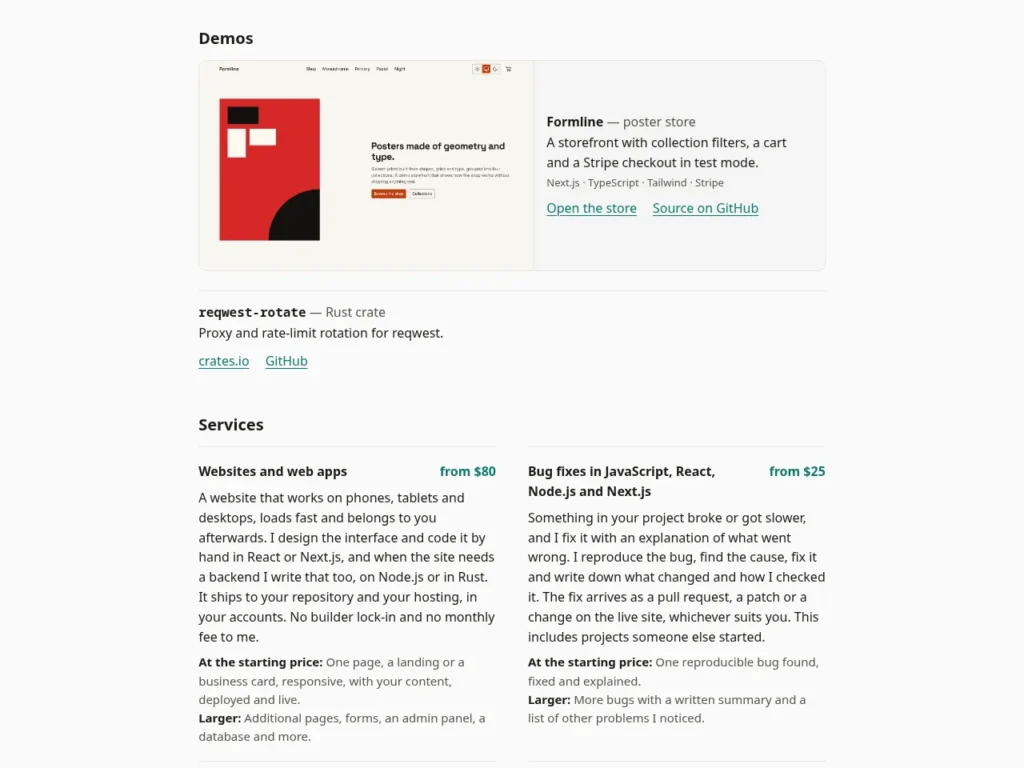
Formline: Next.js store with Stripe
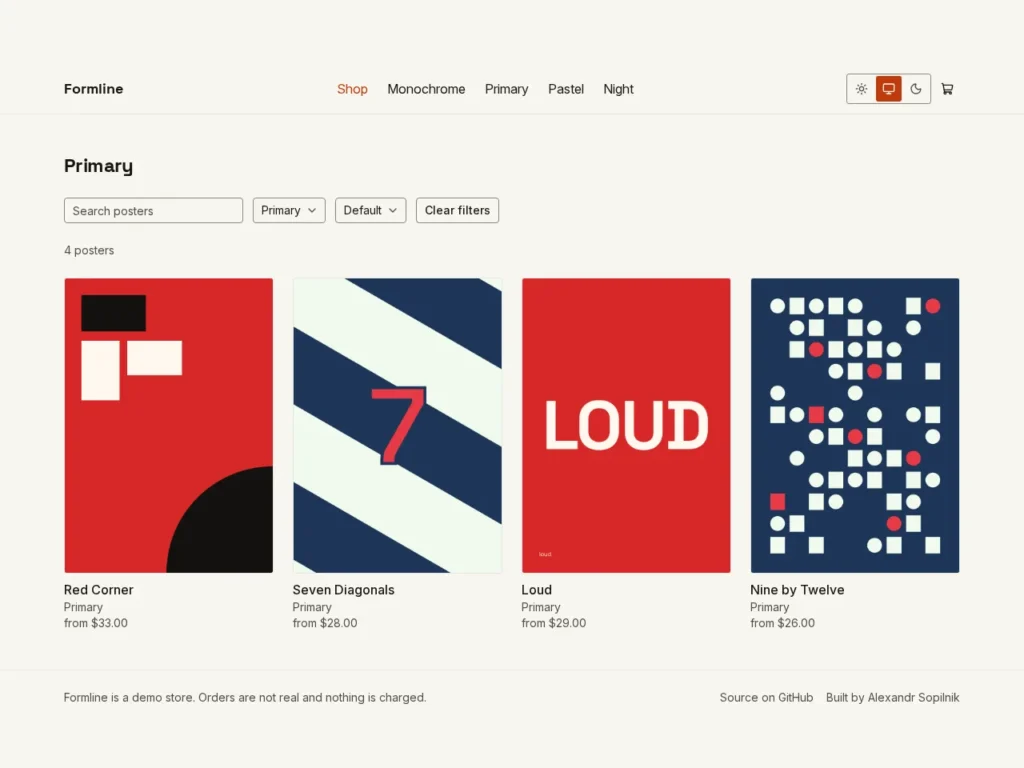
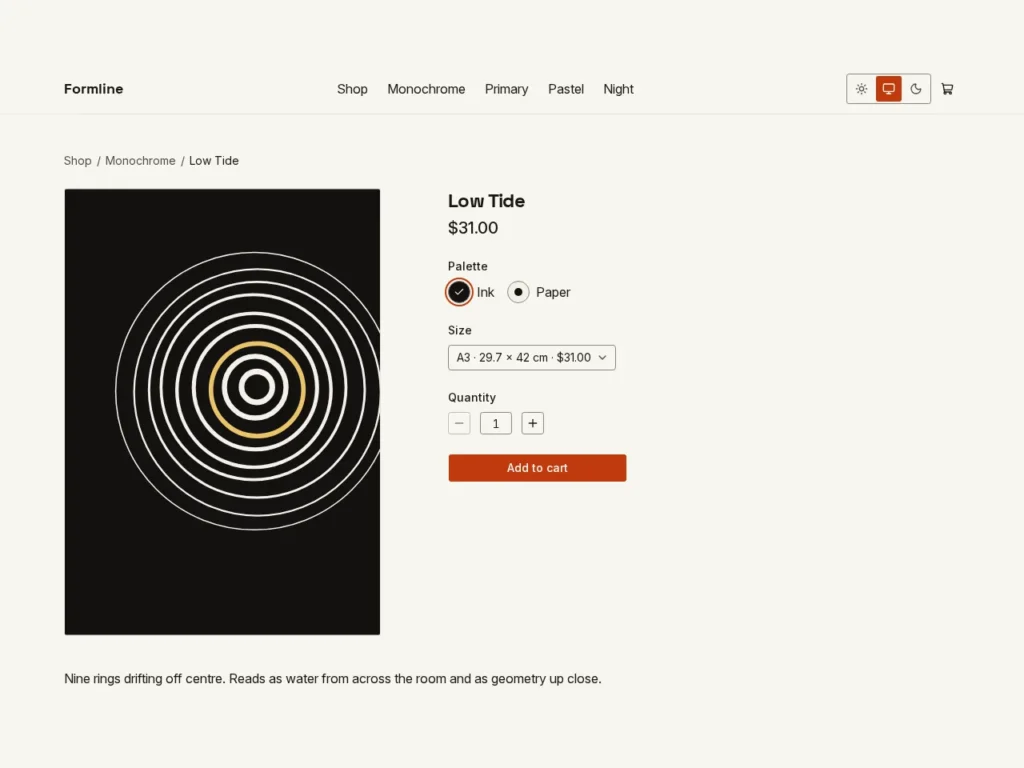
A storefront you can click through: 16 posters in 4 collections, filters and search that stay in the URL, a cart, light and dark themes, and a checkout that ends in a demo order or a real Stripe Checkout session in test mode. I built it as a Next.js static export in TypeScript with Tailwind CSS. Card payments go through a Cloudflare Worker that re-prices the cart on the server and verifies Stripe's webhook signature.


Bilingual personal site in Next.js
A one-page personal site in English and Russian, with a services section and links to my demo projects. I designed and built it with Next.js, React and TypeScript as a static export, styled with plain CSS Modules and no UI framework. It has light and dark themes, and a social preview image for each language is generated at build time. GitHub Actions builds and deploys it to Bunny CDN, which adds security headers and redirects www and plain HTTP to the main HTTPS address.
Service Details
Frequently Asked Questions
Because the product would stand still for months and all the risk would land on one release day. Page by page, every step is small, testable and easy to roll back.
Pages keep their addresses. With Next.js, the new pages reach the browser as ready HTML, rendered on the server or at build time, so search engines see the content as before. React with Vite renders in the browser, so for pages that bring search traffic I recommend Next.js.
Yes. Migrated pages are written in TypeScript, and the old code keeps running as JavaScript until its turn comes.
No. The migration touches the front end only. Where your backend already has endpoints for the data a page needs, the new page uses them. If that data only exists as HTML rendered by PHP today, the plan lists the small JSON endpoints the page needs, and we agree who adds them before that page moves.
Customer Reviews
See what our customers say about this Zinn
Categories
Zinner Policies
Related Zinns