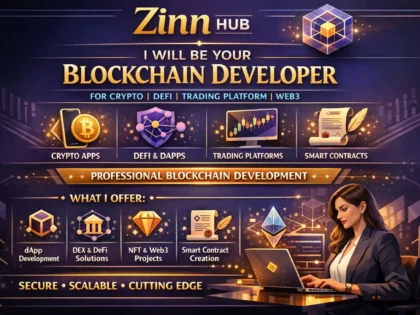
Buy Blockchain Development Services
Blockchain development is the technical foundation of every Web3 project. Whether you are creating a token, launching a presale, building a DeFi protocol, developing a blockchain game, or deploying smart contracts on any chain, the quality of the development determines whether your project succeeds or fails. A poorly written smart contract can be exploited for millions. A badly architected dApp frustrates users and leaks value. A token with broken mechanics cannot be fixed after launch. The stakes in blockchain development are uniquely high because smart contracts are immutable once deployed — mistakes cannot be patched like traditional software.
On Zinn Hub, verified blockchain developers deliver production-grade smart contracts and decentralised applications across every major blockchain network. From Solidity experts building on Ethereum and EVM-compatible chains to Rust specialists deploying on Solana, from full-stack dApp developers to dedicated smart contract auditors — the developers here understand that blockchain code must be secure, gas-efficient, and correct the first time. Every listing accepts cryptocurrency payments, your first $500 is commission-free, and all communication is through the platform for full transparency.
Why Smart Contract Quality Matters
In traditional software development, bugs can be patched with an update pushed to a server. In blockchain development, deployed smart contracts cannot be changed. If a vulnerability exists in your token contract, staking platform, or DeFi protocol, attackers will find it and exploit it. The blockchain space has seen billions of dollars lost to smart contract exploits — reentrancy attacks, flash loan exploits, access control failures, integer overflow bugs, and economic design flaws. Every one of these losses was preventable with proper development practices and security auditing. Hiring an experienced blockchain developer who follows established security patterns, writes comprehensive tests, and understands the specific attack vectors for your type of application is not optional — it is the single most important investment in your project.
Blockchain Development Services on Zinn Hub
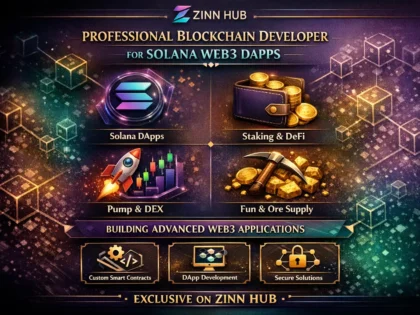
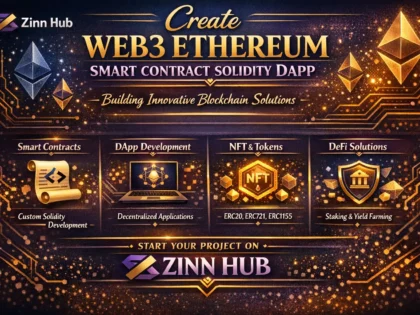
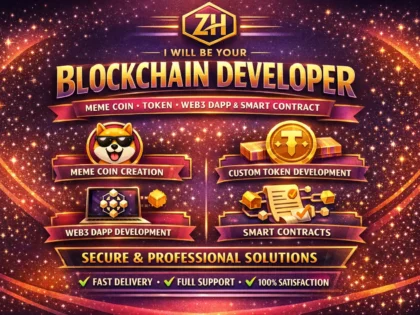
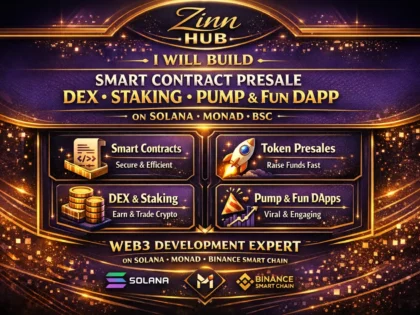
- Smart Contract Development — Custom smart contracts in Solidity for Ethereum and EVM chains or Rust for Solana. Covers token contracts, presale mechanics, staking logic, governance systems, vesting schedules, and any custom on-chain functionality. Includes testnet deployment and comprehensive testing.
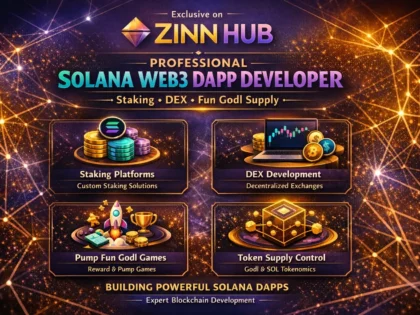
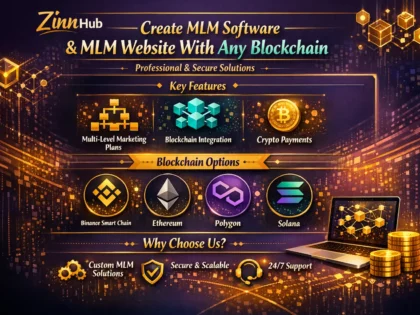
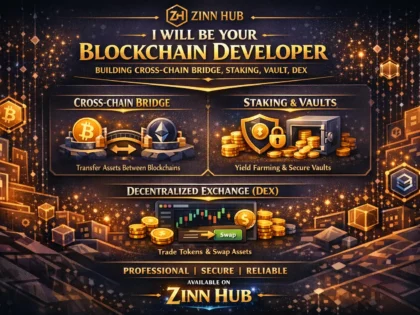
- dApp & DeFi Protocol Development — Full decentralised application builds including smart contracts, frontend interfaces with wallet integration, and on-chain data handling. DEX development, lending protocols, yield farming platforms, bridge solutions, and launchpads. Built for production with security and gas efficiency as priorities.
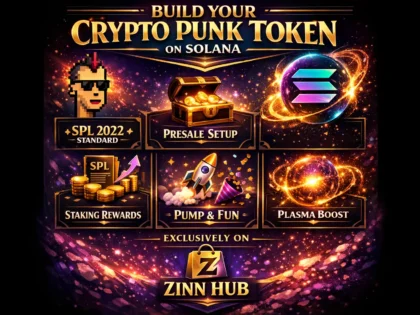
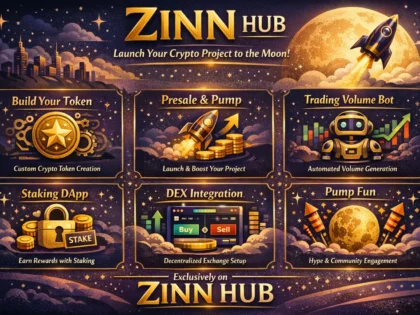
- Token Creation — Token deployment across ERC-20, BEP-20, SPL, and other standards. Standard tokens, deflationary tokens with burn mechanics, reflection tokens with holder rewards, dividend tokens, and multi-chain tokens. Includes contract verification and liquidity setup guidance.
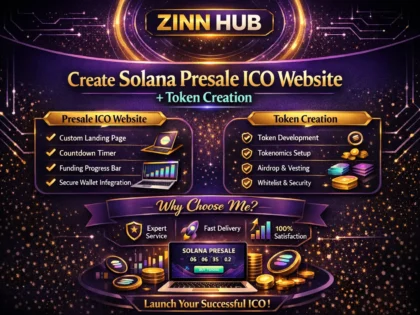
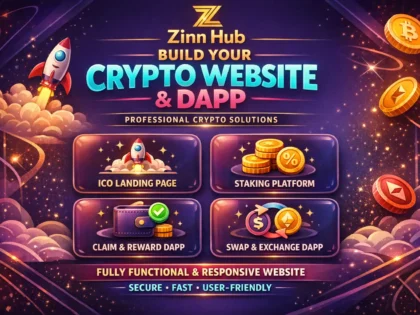
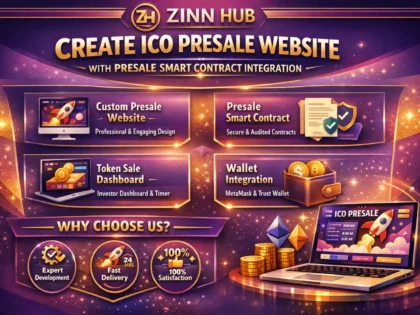
- Presale & ICO Platforms — Complete presale solutions with smart contracts handling contributions, allocation tracking, and token distribution. Frontend websites with wallet connection, presale progress display, and claim functionality. Whitelist systems, vesting schedules, and multi-round support.
- Staking Platforms — Smart contract development for token staking with configurable lock periods, reward calculations, and distribution mechanics. Frontend dashboards showing staking stats, user positions, and reward claims. Supports single-asset staking, LP token staking, and multi-pool configurations.
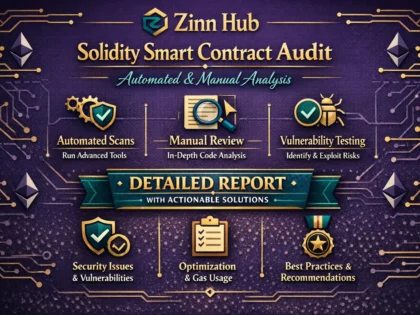
- Smart Contract Auditing — Independent security review of existing smart contracts. Line-by-line code analysis, automated vulnerability scanning, manual exploit testing, gas optimisation review, and detailed reports with severity-rated findings and remediation guidance. Available for contracts on any chain.
- Trading & Volume Bots — Automated trading bots for sniping, market making, arbitrage, volume generation, and copy trading. Built for specific DEXs including Uniswap, Raydium, PancakeSwap, and Jupiter. Telegram bot interfaces for trade execution. Bundle launch bots for coordinated token launches.
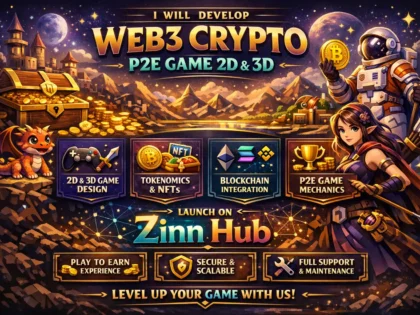
- P2E & Blockchain Games — Play-to-earn game development with blockchain integration for token rewards, NFT assets, and on-chain game mechanics. Telegram mini-games, browser-based games, and full 2D or 3D blockchain gaming experiences with wallet integration and reward distribution.
Choosing the Right Blockchain for Your Project
The blockchain you build on affects transaction costs, speed, user experience, and the developer ecosystem available to you. Ethereum has the largest DeFi ecosystem and most mature tooling but higher gas costs — best for projects targeting the established DeFi community. Solana offers sub-second finality and near-zero fees — ideal for meme coins, high-frequency trading, and consumer applications. BSC provides EVM compatibility with lower fees and a large Asian user base. Polygon, Arbitrum, and Optimism offer Ethereum security with reduced costs through Layer 2 scaling. Base is growing rapidly with Coinbase ecosystem support. Many projects also deploy across multiple chains to reach the widest audience — cross-chain development is available on Zinn Hub.
Related Web3 Services
Blockchain development works alongside other Web3 services to deliver complete projects. For token economics and project strategy, explore tokenomics and consulting services. For NFT-specific smart contracts and collection launches, browse NFT services. For community building after launch, see community management and moderation. For Telegram and Discord bot integration, visit Discord and Telegram services. For the full range of Web3 services, browse the Web3 and Blockchain parent category.
Are you a blockchain developer experienced in Solidity, Rust, or other smart contract languages? Start selling blockchain development services on Zinn Hub and connect with projects worldwide that need expert Web3 development. Register as a Zinner for free and start listing today.
How to Buy Blockchain Development Services
Define Your Technical Requirements Identify the blockchain network, application type — token, presale, staking, DEX, DeFi, or game — and specific features needed. Prepare wireframes or reference projects. Define your budget and timeline.
Choose a Blockchain Developer Browse blockchain development services on Zinn Hub and review portfolios, ratings, and completed projects. Look for experience with your chain and project type. Message developers to discuss requirements before ordering.
Collaborate and Test on Testnet Provide repositories, design files, and documentation. Review progress and provide feedback. Request testnet deployment to test all smart contract functionality with test tokens before mainnet.
Audit, Deploy and Launch For contracts handling funds, commission a security audit before mainnet. Review the audit report and confirm all issues are resolved. Deploy to mainnet, verify contracts on the block explorer, and launch.
Frequently Asked Questions About Blockchain Development Services
What blockchain development services can I buy on Zinn Hub?+
Zinn Hub offers a comprehensive range of blockchain development services from verified developers worldwide. You can buy smart contract development in Solidity Rust and other blockchain languages, dApp development for DeFi lending staking swapping and yield farming protocols, token creation for ERC-20 BEP-20 SPL and other token standards, presale and ICO website builds with smart contract integration, DEX and launchpad development, cross-chain bridge solutions, trading bots and volume bots, P2E and blockchain game development, meme coin launch platforms, smart contract security audits, NFT smart contract integration, crypto wallet integration, and full-stack Web3 application development. Developers cover Ethereum Solana BSC Polygon Arbitrum Avalanche XRPL Cosmos Substrate and all major blockchain networks.
How much does blockchain development cost on Zinn Hub?+
Blockchain development costs vary significantly based on complexity and scope. A standard ERC-20 or SPL token creation costs $200-600. A token with custom features like taxes reflections or dividend distribution costs $500-1,500. A presale website with smart contract integration ranges from $800-3,000. A full staking platform costs $1,500-5,000. DEX or swap platform development ranges from $3,000-15,000 depending on features and chains supported. A DeFi lending or yield farming protocol costs $5,000-20,000. Smart contract security audits range from $300-2,000 based on codebase size and complexity. Trading bot and volume bot development costs $500-3,000. P2E game development with blockchain integration ranges from $2,000-15,000. Prices depend on the developer experience level, blockchain network, and project complexity.
What is a smart contract and why do I need one?+
A smart contract is a self-executing programme stored on a blockchain that automatically enforces the rules and conditions written into its code. When specific conditions are met the contract executes the agreed actions without needing a middleman. Smart contracts power virtually everything in Web3 — token launches define the token supply distribution and transfer rules, presales automate the fundraising process and token distribution, staking platforms calculate and distribute rewards automatically, DEXs facilitate token swaps through automated market making, NFT collections handle minting ownership and royalty payments, and DAOs enable decentralised voting and treasury management. You need a smart contract whenever you want to create a token, build any DeFi functionality, launch an NFT collection, or automate any on-chain process. The quality of your smart contract directly determines the security and reliability of your entire project.
Which blockchain should I build on?+
The right blockchain depends on your project requirements and target audience. Ethereum is the most established with the largest DeFi ecosystem and developer tooling but has higher gas fees. Solana offers extremely fast transactions and low fees making it popular for meme coins trading platforms and high-frequency DeFi applications. BSC BNB Chain provides EVM compatibility with lower fees than Ethereum and a large user base. Polygon offers Ethereum compatibility with dramatically reduced gas costs. Arbitrum and Optimism are Ethereum Layer 2 solutions that combine Ethereum security with lower costs. Avalanche offers fast finality and subnet customisation. Base is growing rapidly with strong Coinbase ecosystem support. A blockchain developer on Zinn Hub can advise on the best chain for your specific project based on your target users, transaction volume expectations, and feature requirements.
What is a smart contract audit and do I need one?+
A smart contract audit is a thorough security review of your smart contract code by an experienced auditor who examines it for vulnerabilities, logic errors, gas inefficiencies, and potential exploits. The auditor tests attack vectors including reentrancy attacks, integer overflow and underflow, front-running vulnerabilities, access control weaknesses, and economic exploits. You absolutely need an audit if your smart contract handles user funds in any capacity — tokens, staking, presales, DEXs, lending, or any DeFi protocol. Unaudited smart contracts are the primary target for hackers and the blockchain space has lost billions to exploits in contracts that were never properly reviewed. Even for simpler token contracts an audit catches bugs that could lock liquidity, break transfers, or create unintended minting vulnerabilities. The cost of an audit is a fraction of the potential losses from a successful exploit.
What is a presale dApp and how does it work?+
A presale dApp is a decentralised application that allows investors to purchase your token before it launches on public exchanges, typically at a discounted price. The presale smart contract handles contribution collection in ETH SOL BNB or stablecoins, enforces minimum and maximum contribution limits, tracks each investor allocation, and automatically distributes tokens once the presale concludes. A presale dApp website provides the user interface where investors connect their wallet, view presale progress and token information, contribute funds, and claim their tokens. Most presale platforms also include features like referral systems, vesting schedules for token distribution, whitelist functionality, and multiple presale rounds with different pricing tiers. Blockchain developers on Zinn Hub build complete presale solutions including the smart contract, frontend website, and wallet integration.
What is DeFi development?+
DeFi or decentralised finance development involves building financial applications that run on blockchain networks without traditional intermediaries like banks or brokers. DeFi applications include decentralised exchanges or DEXs where users swap tokens through automated market maker pools, lending and borrowing platforms where users supply assets to earn interest or borrow against collateral, yield farming protocols where users provide liquidity and earn reward tokens, staking platforms where users lock tokens to earn rewards and support network operations, bridge protocols that allow assets to move between different blockchain networks, and launchpad platforms that facilitate new token launches and fundraising. DeFi development requires deep understanding of smart contract security, economic model design, liquidity mechanics, and cross-protocol integrations. Developers on Zinn Hub build custom DeFi protocols from scratch or fork and customise existing proven protocols.
Can you build trading bots and volume bots?+
Yes. Blockchain developers on Zinn Hub build various types of automated trading and volume bots. These include sniping bots that detect and execute trades on new token listings within milliseconds, volume bots that generate organic-looking trading activity to improve market presence and chart visibility, arbitrage bots that detect price differences across DEXs and execute profitable trades automatically, market making bots that provide liquidity and maintain bid-ask spreads, copy trading bots that replicate the trades of specified wallets, and Telegram trading bots that allow users to execute trades directly from Telegram commands. Bots are built for specific chains and DEXs including Uniswap Raydium PancakeSwap Jupiter and others. Developers can also build bundle launch bots for coordinated token launches on platforms like Pump Fun.
How long does blockchain development take?+
Timelines vary based on project complexity. A standard token creation with basic features takes 1-3 days. A token with custom mechanics like taxes reflections or dividend distribution takes 3-7 days. A presale website with smart contract integration takes 5-14 days. A staking platform takes 7-14 days. A full DEX or swap platform takes 2-6 weeks. A DeFi lending protocol takes 4-8 weeks. A P2E blockchain game takes 4-12 weeks depending on complexity. Smart contract audits take 3-14 days based on codebase size. Trading bot development takes 5-14 days. These are typical ranges and your specific timeline depends on feature requirements, the number of chains to support, frontend complexity, and how quickly you provide feedback during development. Discuss timelines with your developer before ordering to set clear expectations.
What should I look for when hiring a blockchain developer?+
When hiring a blockchain developer on Zinn Hub check their experience with your specific blockchain network and project type. Review their portfolio for completed projects similar to yours — a developer who has built multiple staking platforms is a safer choice for your staking project than a generalist. Read buyer reviews carefully, paying attention to comments about code quality, security awareness, communication, and delivery reliability. For smart contract work specifically, ask whether they follow established security patterns, whether they write tests for their contracts, and whether they can deploy to testnet for your review before mainnet. Check which programming languages they work in — Solidity for Ethereum and EVM chains, Rust for Solana, Move for Sui and Aptos. For full-stack dApp development, confirm they can handle both the smart contract backend and the frontend wallet integration. Message developers before ordering to discuss your specific requirements and assess their understanding of your project.
Do blockchain developers on Zinn Hub also handle frontend development?+
Many blockchain developers on Zinn Hub offer full-stack Web3 development covering both the smart contract backend and the frontend interface. A typical full-stack delivery includes smart contracts deployed to your chosen blockchain, a React or Next.js frontend application, wallet connection integration supporting MetaMask WalletConnect Phantom and other popular wallets, on-chain data reading and transaction execution through the interface, responsive design for desktop and mobile, and deployment to hosting. However some developers specialise only in smart contract development without frontend work. Check the service description and ask the developer before ordering if you need both smart contract and frontend development. For complex projects you may benefit from hiring separate smart contract and frontend specialists to get the best expertise in each area.
Can I get my existing smart contract audited?+
Yes. Smart contract auditing is available as a standalone service on Zinn Hub. You do not need to have the contract built here to get it audited. Auditors review contracts written by any developer on any supported chain. A typical audit includes a line-by-line code review, automated vulnerability scanning using tools like Slither and Mythril, manual testing of attack vectors, gas optimisation recommendations, a detailed report listing all findings categorised by severity from critical to informational, and remediation guidance for each issue found. Some auditors also provide a follow-up review after you implement their recommended fixes to confirm the vulnerabilities have been properly addressed. For maximum security it is best practice to have your contract audited by someone who did not write it — an independent reviewer brings fresh eyes and different testing approaches.



 ✓
✓ ✓
✓ ✓
✓ ✓
✓ ✓
✓ ✓
✓ ✓
✓