Table of Contents
AI tools have exploded into every corner of digital work. ChatGPT writes content. Midjourney creates images. GitHub Copilot writes code. If you’re a business owner who hires freelancers, you’re probably asking a very reasonable question: why would I pay a human when AI can do it faster and cheaper?
The answer is nuanced. AI is genuinely transformative for certain tasks. But for others, it produces work that looks competent on the surface and falls apart under scrutiny. Knowing the difference — and knowing when to use each — is the competitive advantage that separates smart buyers from those who waste money on the wrong approach.
Where AI Genuinely Excels
Let’s give credit where it’s due. AI tools are remarkable at specific categories of work, and using them for these tasks is a no-brainer.
First Drafts and Brainstorming
AI is exceptional at generating raw material quickly. Need 20 headline options for a landing page? A rough draft of a product description? An outline for a blog post? AI delivers in seconds what would take a human 30 minutes. The output needs editing, but as a starting point, it’s invaluable.
Data Processing and Analysis
AI handles large-scale data tasks with speed and accuracy that humans can’t match. Cleaning spreadsheets, extracting patterns from datasets, categorising thousands of items, generating reports from structured data — these are AI’s sweet spot.
Code Generation for Standard Patterns
AI coding assistants are excellent at generating boilerplate code, writing standard functions, and implementing well-documented patterns. If you need a standard REST API endpoint or a common UI component, AI can write it in seconds.
Translation of Straightforward Content
For simple, factual content like product listings, technical documentation, and internal communications, AI translation has reached a quality level that’s genuinely useful. It’s not perfect, but for non-creative text, it’s often good enough.
Image Generation for Concepts and Placeholders
AI image generators are excellent for mood boards, concept exploration, placeholder visuals, and social media graphics that don’t require brand-specific precision. They’ve dramatically lowered the barrier to visual content creation.
Where AI Falls Short
Here’s where things get important. AI’s weaknesses aren’t always obvious — and that’s what makes them dangerous. AI work can look professional while being fundamentally flawed in ways that damage your business.
Strategic Thinking and Business Context
AI has no understanding of your business, your customers, your competitive landscape, or your goals. It generates content based on patterns in its training data, not based on what will actually work for your specific situation.
A human SEO strategist who understands your industry will identify keyword opportunities that AI misses entirely. A human copywriter who understands your brand voice will write copy that resonates with your specific audience. AI gives you generic — a human gives you strategic.
Original Creative Work
AI remixes existing patterns. It doesn’t create genuinely original ideas. For branding, advertising, creative direction, and any work where standing out from competitors matters, AI produces work that’s competent but forgettable. It’s the visual and verbal equivalent of background music — pleasant but indistinguishable.
If your brand identity looks like everyone else’s AI-generated brand identity, you haven’t built a brand. You’ve created wallpaper.
Quality Judgment
AI can’t evaluate whether its own output is good. It produces text with confident fluency regardless of whether the content is accurate, relevant, or useful. It generates code that runs but may be inefficient, insecure, or poorly architected. It creates designs that are visually acceptable but strategically meaningless.
Someone needs to evaluate the quality — and that someone needs to be human. This is why the smartest approach isn’t AI vs human but AI plus human.
Nuanced Communication
Sales copy, customer communications, sensitive emails, negotiation, and anything requiring emotional intelligence or cultural awareness is beyond AI’s capabilities. AI can write a grammatically correct email. It can’t write an email that navigates a delicate client relationship or defuses a complaint with empathy.
Accountability and Revision
When AI delivers something wrong, you can’t brief it on what went wrong in a meaningful way. You can re-prompt and hope for better output. With a human freelancer, you can have a conversation, provide specific feedback, and get targeted revisions. The iterative process of refining work through collaboration is something AI fundamentally can’t replicate.
When to Hire a Human Freelancer
Use human freelancers when the work requires any of the following:
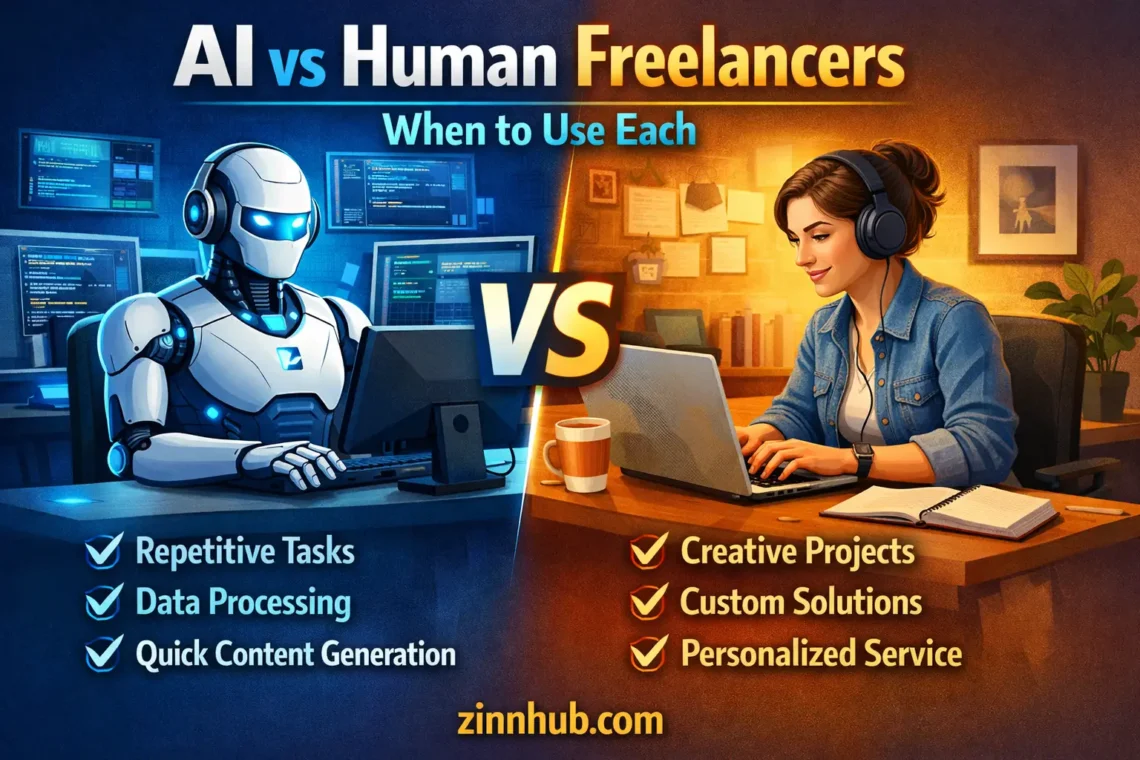
- Business strategy or judgment — SEO strategy, marketing planning, brand development, business consulting
- Original creative work — Logo design, brand identity, advertising campaigns, creative copywriting, custom illustration
- Technical expertise with accountability — Website development, security audits, complex integrations, architecture decisions
- Specialised knowledge — Legal writing, medical content, financial analysis, industry-specific consulting
- Client-facing communication — Sales copy, customer service scripts, executive communications, PR
- Quality that must be verifiable — Anything where errors have consequences (technical documentation, compliance content, published articles)
- Ongoing relationships — Projects that benefit from someone who learns your business over time
For these tasks, platforms like Zinn Hub let you browse verified human freelancers across dozens of categories, check real buyer reviews, and hire with payment protection. The human element — accountability, expertise, and judgment — is exactly what you’re paying for.
When to Use AI Tools
Use AI when the work is:
- High volume, low complexity — Bulk data processing, repetitive formatting, template-based content
- Exploratory or preliminary — First drafts, brainstorming, concept generation, research summaries
- Internal, not client-facing — Meeting notes, internal documentation, rough calculations
- Speed-critical with low stakes — Social media posts, internal emails, quick mockups
- Supplementary to human work — AI-generated outlines that a human writer develops, AI code that a human developer reviews and refines
The Smart Approach — Combining Both
The buyers getting the best results in today’s market aren’t choosing between AI and human freelancers. They’re combining both strategically.
The AI-Assisted Freelancer
The most effective freelancers already use AI as part of their workflow. A content writer uses AI for research and outlines, then applies their expertise to create strategic, original content. A developer uses AI for boilerplate code, then focuses their human intelligence on architecture, optimisation, and problem-solving.
When you hire a skilled freelancer, you’re often getting the efficiency of AI tools combined with the judgment, creativity, and accountability of a professional. This is the best of both worlds.
Practical Workflow
Here’s how smart buyers structure their approach:
- Use AI for the 80% that’s straightforward — Generate drafts, process data, create templates
- Hire humans for the 20% that matters most — Strategy, creative direction, quality review, client-facing deliverables
- Let freelancers use AI tools — Don’t penalise freelancers for using AI as part of their process. The output quality and strategic value is what you’re paying for, not the method
How This Changes What You Should Pay For
AI has shifted the value equation in freelancing. Here’s what this means for buyers:
Commodity Work Is Cheaper
Tasks that AI can handle adequately — basic content, simple graphics, data entry — have become cheaper because the supply has increased. Don’t overpay for work that AI could do just as well.
Strategic Work Is More Valuable
The flip side: work that requires genuine expertise, creativity, and judgment has become more valuable precisely because AI can’t replicate it. A skilled brand strategist, a senior developer who makes architectural decisions, or an SEO expert who identifies non-obvious opportunities — these professionals are worth more, not less, in the AI era.
Quality Verification Is Critical
With AI-generated work flooding every marketplace, the ability to verify quality matters more than ever. Platforms with verified buyer reviews, portfolio requirements, and quality standards help you distinguish between genuine professionals and people who paste your brief into ChatGPT and submit the output.
Zinn Hub’s guided service creation process includes AI-powered quality checks that help ensure listings represent genuine expertise. Combined with verified buyer reviews and a marketplace structure that rewards quality over volume, it’s designed to surface the freelancers who actually deliver value.
The Future Is Collaboration, Not Replacement
The narrative that AI will replace all freelancers is as wrong as the narrative that AI isn’t changing anything. The reality is in the middle: AI is transforming how work gets done, but the need for human expertise, creativity, and accountability isn’t going away.
The freelancers who thrive will be those who use AI to enhance their efficiency while delivering the strategic value, original thinking, and professional judgment that AI can’t replicate. The buyers who get the best results will be those who understand when each approach is appropriate.
Need to find human freelancers with genuine expertise? Browse Zinn Hub’s service marketplaces to find verified professionals across every digital skill category. Every seller has real reviews from real buyers, and your payment is protected until work is delivered and verified.
Looking to offer your AI-enhanced freelance services? Create your free Zinn Hub account and start listing your services. Our guided Zinn creation wizard helps you build listings that showcase your unique human expertise — the stuff AI can’t copy.