
Table of Contents
If you run a business that serves customers in a specific area — a restaurant, plumber, dental practice, estate agent, gym, or any other local service — then local SEO is the most cost-effective marketing investment you can make. It puts you in front of people who are actively searching for what you offer, in the exact moment they need it.
“Near me” searches have grown exponentially over the past decade, and the businesses that show up in Google’s Local Pack (that map with three business listings at the top of search results) capture the vast majority of local clicks. This guide shows you exactly how to get there.
What Is Local SEO?
Local SEO is the process of optimising your online presence so your business appears in search results for location-specific queries. When someone searches “plumber in Manchester” or “best coffee shop near me,” Google uses a different algorithm than it does for generic searches. Local SEO focuses on the signals that this algorithm prioritises.
The three main ranking factors for local search are relevance (how well your business matches the search query), distance (how close your business is to the searcher), and prominence (how well-known and trusted your business is online). Your local SEO strategy should address all three.
Google Business Profile: Your Foundation
Your Google Business Profile (formerly Google My Business) is the single most important element of local SEO. It’s the information Google uses to display your business in the Local Pack, Google Maps, and the knowledge panel that appears when someone searches your business name.
Setting Up and Optimising Your Profile
Claim your profile at business.google.com if you haven’t already. Then optimise every field: use your exact, real business name (don’t stuff keywords into it — Google penalises this). Select the most specific primary category that fits your business, and add all relevant secondary categories. Write a compelling business description that naturally includes your services and location. Add your full address (or service area if you don’t have a physical shopfront), phone number, website URL, and accurate opening hours.
Photos and Visual Content
Businesses with photos on their Google Business Profile get 42% more requests for driving directions and 35% more click-throughs to their website than those without. Upload high-quality photos of your premises, team, products, and work. Add new photos regularly — Google favours profiles that are actively maintained.
Google Business Profile Posts
These are short updates that appear on your profile — similar to social media posts. Use them to share offers, events, new services, or helpful tips. They expire after seven days, so post weekly to keep your profile active. Posts don’t directly affect rankings, but they improve engagement and conversion rates.
Local Keyword Research
Local keywords differ from generic keywords in that they include geographic modifiers. “Plumber” is generic; “plumber in Leeds” is local. Your keyword strategy should cover explicit local terms (service + location, like “web design agency Manchester”), implicit local terms (searches where Google infers local intent, like “plumber near me” or simply “plumber” when searched from a mobile device), and long-tail local queries (“emergency boiler repair south Manchester weekend”).
Tools for local keyword research include Google’s Keyword Planner, Semrush, Ahrefs, and Google Search Console (which shows what queries are already driving impressions for your site). Don’t forget to research the specific neighbourhoods and suburbs your customers use — “Chorlton plumber” may have less search volume than “Manchester plumber” but much less competition.
On-Page SEO for Local Businesses
Location-Specific Pages
If you serve multiple areas, create dedicated pages for each one. A plumber serving Greater Manchester might have separate pages for Manchester city centre, Stockport, Salford, Trafford, and Bolton. Each page should have unique content relevant to that area — not just the same text with the location name swapped in.
Title Tags and Meta Descriptions
Include your primary service and location in your title tags: “Emergency Plumber in Stockport | 24/7 Call-Out | [Business Name].” Meta descriptions should include a call to action and your location: “Trusted Stockport plumber with 15+ years experience. Same-day service, no call-out charge. Call now on [number].”
Schema Markup
Local business schema markup helps Google understand your business details in a structured format. Include your business name, address, phone number, opening hours, service area, and business type using LocalBusiness schema. This can improve your appearance in rich results and the Local Pack.
NAP Consistency
NAP stands for Name, Address, Phone number. Your NAP must be identical — character for character — everywhere it appears online: your website, Google Business Profile, social media profiles, directories, and citations. Inconsistent NAP information confuses Google and undermines your local rankings.
Local Link Building
Backlinks from local websites are particularly valuable for local SEO. Sources to target include local business directories and chambers of commerce, local news websites and community blogs, sponsorship of local events, teams, or charities, partnerships with complementary local businesses, and local industry associations.
A link from your city’s chamber of commerce or a local news site carries more local SEO weight than a generic backlink from a national directory. For broader link building strategies, read our guides on understanding backlinks and guest posting.
If you need help building local links, browse Local SEO professionals on Zinn Hub who specialise in local search optimisation, or check backlink building services for targeted link acquisition.
Reviews: The Trust Factor
Online reviews are a critical local ranking factor and the primary way potential customers evaluate your business before making contact. Google has confirmed that review quantity, frequency, and diversity of review platforms all influence local rankings.
Build a systematic review generation process: ask every satisfied customer for a review (timing matters — ask when they’re most happy with your service), make it easy by sending a direct link to your Google review page, respond to every review — positive and negative — professionally and promptly, and never buy fake reviews or incentivise reviews with discounts (both violate Google’s terms).
For more strategies on building your review profile, read our guide on getting more client reviews.
Local Citations and Directories
Citations are mentions of your business name, address, and phone number on other websites — even without a link. Key citation sources include Yell (UK), Yelp, Thomson Local, Bing Places, Apple Maps, Facebook Business, industry-specific directories relevant to your trade, and local council business listings.
Consistency is critical — ensure your NAP is identical across every directory. Tools like BrightLocal and Whitespark can audit your citations and identify inconsistencies.
Tracking Local SEO Performance
Monitor your local SEO efforts with Google Business Profile Insights (shows how customers find your profile, what actions they take, and where they come from), Google Search Console (tracks which queries drive traffic to your website), Google Analytics (measures website traffic, conversions, and user behaviour), and local rank tracking tools (BrightLocal, Whitespark, or Semrush’s local tracking features).
Key metrics to track include Local Pack visibility for your target keywords, Google Business Profile views and actions (calls, direction requests, website clicks), organic traffic from location-specific pages, review quantity and average rating, and conversion rate from local search traffic.
When to Hire a Local SEO Professional
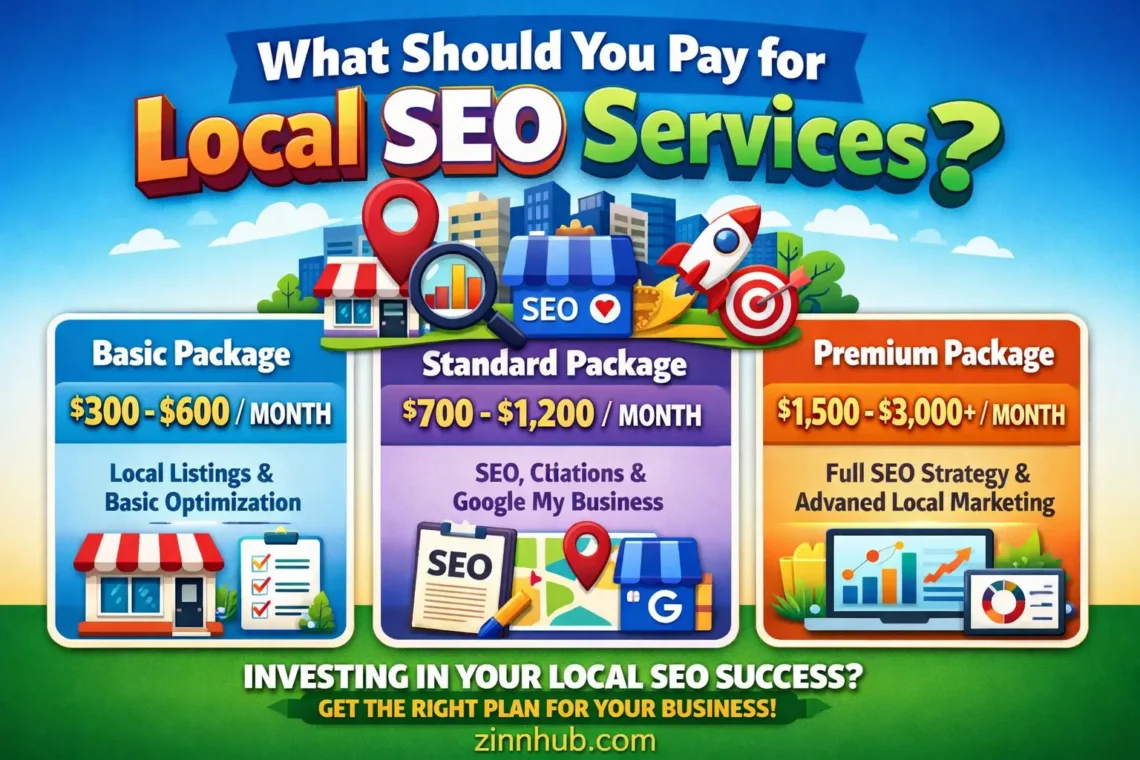
Local SEO is manageable for many small business owners, but it does require consistent time and effort. If you’d rather focus on running your business, hiring a freelance SEO specialist can be cost-effective — particularly for competitive local markets where ranking requires more aggressive strategy.
Browse SEO freelancers on Zinn Hub or check location-specific providers for cities like Manchester, London, or Birmingham. If you’re an SEO professional yourself, list your local SEO services on the marketplace to reach businesses actively looking for help.
Frequently Asked Questions
How long does local SEO take to show results?
Most businesses see initial improvements within three to six months of consistent effort. Competitive markets may take longer. Quick wins include optimising your Google Business Profile and fixing NAP inconsistencies, which can show results within weeks.
Do I need a physical address for local SEO?
Not necessarily. Service-area businesses (those that travel to customers rather than having customers visit) can set up a Google Business Profile with a service area instead of a displayed address. However, having a physical location does provide additional ranking signals.
How important are reviews compared to other factors?
Reviews are one of the top three local ranking factors alongside Google Business Profile optimisation and on-page SEO. More importantly, they directly influence whether potential customers contact you — 87% of consumers read online reviews for local businesses. A business with 50 five-star reviews will almost always outperform a competitor with 5 reviews, even if the competitor’s website is better optimised.
Can I do local SEO myself or do I need to hire someone?
Many elements of local SEO citations are accessible to non-technical business owners: Google Business Profile optimisation, review management, and basic on-page SEO are all learnable. More technical aspects like schema markup, advanced link building, and competitive analysis may benefit from professional help. Start with the basics yourself and consider hiring for the more complex elements.